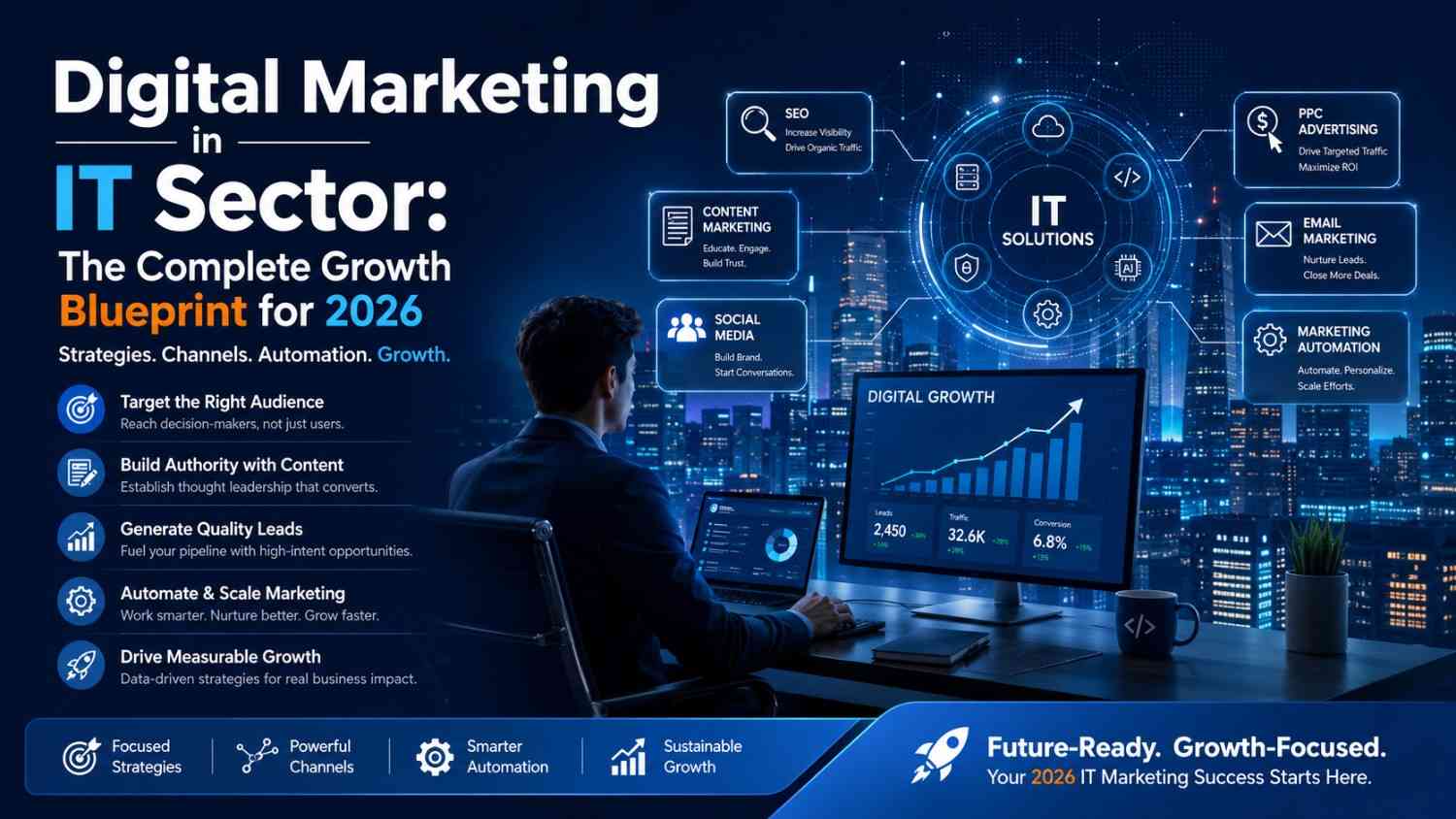
Digital Marketing in IT Sector: The Complete Growth Blueprint for 2026
Expert Senior SEO Strategist with 15+ years in enterprise SEO, B2B lead generation, topical authority, semantic SEO, content marketing, and conversion rate optimization for IT sector growth.
95% of B2B buyers are out of market at any given time, and
the average B2B sales cycle runs 379 days. Yet most IT marketing guides hand
you the same generic playbook designed for selling HR software to a single
VP—as if marketing cybersecurity infrastructure to a 10-person buying committee
is the same game.
It's not. Digital marketing in the IT sector works
differently because your audience is more technical, more skeptical, and more
committee-driven than almost any other B2B segment. The strategies that work
for a marketing automation vendor won't survive first contact with a CISO who
wants your SOC 2 report before they'll even take a meeting.
Current digital transformation trends are reshaping how IT
buyers evaluate solutions. AI overviews and generative search are now the
primary way technical buyers find information, meaning your content needs to be
structured for extraction—not just traditional keyword optimization. Meanwhile,
cookie deprecation and privacy tools (which IT buyers adopt faster than any
other segment) mean roughly 70% of your website traffic is anonymous.
The common challenges IT companies face include:
- Massive
buying committees: 10-11 stakeholders per deal, with 79% requiring CFO
sign-off
- Compliance
as table stakes: SOC 2, ISO 27001, pentest results required before
technical evaluation
- Attribution
blindness: IT buying decisions happen in "dark
social"—private Slack groups, WhatsApp threads, closed Discord
communities
- Long
sales cycles: 379 days average, requiring marketing to maintain
engagement across months
This complete growth blueprint provides real benchmarks,
actionable buyer personas, and a framework you can execute against—not another
recycled listicle.
Section 2: What Is Digital Marketing in the IT Sector?
Digital marketing in the IT sector refers to the strategies
and tactics technology companies use to promote their products or services to
other businesses rather than individual consumers. Unlike B2C marketing, where
emotional appeals and impulse purchases drive decisions, IT sector digital
marketing operates on longer sales cycles, multiple stakeholders, and rational
evaluation criteria.
The distinction matters because your audience isn't
scrolling social media looking for entertainment. They're researching solutions
to specific business problems: reducing infrastructure costs, improving
security compliance, automating workflows, or scaling operations.
B2B marketing technology has evolved dramatically. Marketing
teams now rely on sophisticated platforms—CRMs, marketing automation systems,
account-based marketing tools, and AI-powered analytics dashboards—to track
buyer behavior across multiple touchpoints. This tech stack enables the
precision targeting and measurement that modern B2B IT campaigns require.
Key difference from generic B2B: B2B IT marketing
covers the full spectrum of technology products and services—managed services,
infrastructure, cybersecurity, consulting, and hardware—while general B2B
marketing often focuses on softer business solutions. IT marketing typically
involves longer sales cycles (379 days average), more stakeholders (10-11), and
heavier compliance requirements like SOC 2 and ISO 27001.
Section 3: Why Digital Marketing Matters for IT
Businesses in 2026
Market Competition
The CAC trend is moving in the wrong direction—median
new-customer acquisition cost is up 14% year-over-year, now sitting at $2 for
every $1 of new ARR. Payback periods have increased 12.5% since 2022. This
makes channel efficiency and data quality more important than ever.
For growth-stage IT companies, the math only works if you're
moving upmarket. If your average contract value is under $25k, you probably
can't afford a 379-day sales cycle. Either shorten the cycle with product-led
growth, or move upmarket where the unit economics justify the committee-driven
buying process.
Online Buyer Behavior
Modern B2B buyers interact with vendors across numerous
channels before making contact. They might discover you through:
- Organic
search when researching solutions
- LinkedIn
ads targeting specific job titles
- Industry
publications and newsletters
- Peer
recommendations in online communities
- Conference
presentations and trade shows
- Podcast
interviews with your executives
- YouTube
tutorials demonstrating your platform
Each channel serves different stages of the buyer journey.
Someone just beginning research might start with educational blog content.
Someone actively evaluating vendors wants product comparison sheets and pricing
information.
Trust Building
81% of B2B buyers ultimately purchase from a brand they
already knew on Day 1 of their buying process. If you're not in the
consideration set before the buyer starts evaluating, your demand gen campaigns
are fighting for the remaining 19%.
For IT companies, brand investment means thought leadership
that demonstrates genuine technical expertise. Your CTO publishing architecture
decisions. Your security team sharing incident response learnings. Your
engineering blog becoming a resource that buyers bookmark. When the 379-day
sales cycle finally reaches the evaluation phase, the company whose content the
buyer has been reading for six months has a significant advantage.
B2B brand fame campaigns deliver 2.2x ROI versus 0.7x for
pure activation campaigns.
Demand Generation
The data on brand investment is unambiguous. The model is
moving from awareness-based marketing to influence-based marketing, where
pipeline contribution replaces MQL volume as the north star.
For IT marketing teams, this means your KPIs need to align
with pipeline and revenue, not just MQL volume. If your marketing dashboard
doesn't show pipeline contribution by channel, fix that before optimizing
anything else.
Customer Acquisition
Here are concrete benchmarks on what "good" looks
like:
|
Channel |
CPL |
Notes |
|
SEO |
$31 |
Lowest cost, 3-6 mo. ramp |
|
Email |
$53 |
Requires clean data |
|
Webinars |
$72 |
Strong mid-funnel |
|
Content |
$92 |
Compounds over time |
|
PPC |
$181 |
Volume play, high intent |
|
Trade Shows |
$811 |
Relationships, not leads |
|
Metric |
Average |
Top Performers |
|
MQL-to-SQL |
15-21% |
25-35% |
|
LinkedIn MQL-to-SQL |
14-18% |
|
|
Google Ads MQL-to-SQL |
7-12% |
|
|
CAC ratio |
$2 per $1 new ARR |
|
|
SaaS median growth |
26% |
|
|
NRR |
101% |
SEO and content marketing at $31 CPL has the longest ramp
time (3-6 months) but the lowest cost per lead and compounds over time. Pair it
with email outreach using verified contact data for faster pipeline generation
while your content engine builds momentum.
Section 4: Top Digital Marketing Strategies for IT
Companies
SEO and Content Marketing
Organic search delivers the lowest cost per lead in B2B at
$31, while content marketing as a broader category runs $92 CPL. Both compound
over time, unlike paid channels where spend stops and leads stop.
IT-specific content that consistently performs:
- Comparison
pages (your product vs. alternatives)
- Integration
guides
- Security
compliance documentation
- "How
we built X" engineering blog posts
IT buyers are early adopters of AI-powered search tools,
which means your content needs to be structured for extraction—clear answers,
well-organized data, schema markup—not just traditional keyword optimization.
The execution model that works: Only target topics
where you can create content that's 3-5x better than the current #1 result. One
team using this approach saw 268% traffic growth in six months, going from 90k
to 242k monthly visitors.
Technical SEO
For IT companies, technical SEO goes beyond standard best
practices. Your content needs schema markup for extraction by AI overviews.
Architecture diagrams, API documentation, and security certifications should be
publicly accessible without form fills.
Make technical evaluation possible without requiring sales
conversations. This transparency accelerates sales cycles—prospects can
complete technical due diligence independently, eliminating weeks of
back-and-forth requesting information.
LinkedIn Marketing
89% of B2B marketers use LinkedIn for lead gen, and 40% cite
it as their most effective channel for high-quality leads. LinkedIn's
MQL-to-SQL conversion rate of 14-18% versus Google's 7-12% makes it the clear
winner for lead quality, even though CPLs are higher.
For IT marketing specifically, LinkedIn's targeting by job
title and company size lets you reach the exact stakeholders in your proof
matrix.
LinkedIn Benchmarks:
- Average
CTR: 0.44–0.65%
- Average
conversion rate (ad click to form fill): 6–11% for Lead Gen Forms; 1.5–3%
for landing page traffic
- Average
conversion rate (click to lead): 2.7–5.8%
PPC Advertising
For IT companies running paid campaigns, budget allocation
matters more than total spend:
|
Platform |
Budget Share |
Why |
|
Google Ads |
35-45% |
High intent, $48.96 CPL, 3.75% conversion rate |
|
LinkedIn |
25-35% |
Best MQL-to-SQL (14-18%), unmatched targeting |
|
Bing |
15-20% |
253% ROI, massively overlooked |
|
Meta |
5-10% |
Retargeting only |
The most overlooked channel? Bing Ads. It delivers the
highest ROI of any major B2B platform. IT decision-makers skew toward Bing more
than you'd expect, partly because of Microsoft ecosystem defaults in enterprise
environments.
Median landing page conversion rate for B2B SaaS is
2.5–4.0%. Top quartile achieves 5–8%.
Email Marketing
Email runs a $53 CPL—competitive with most channels and
significantly cheaper than paid or events. But it's also the channel most
damaged by bad data.
Bounce rates above 5% don't just waste sends; they destroy
your domain reputation, which tanks deliverability for every future campaign.
Industry-average data refresh cycles run 6 weeks, which means by the time
you're sending outreach, a meaningful percentage of your contacts have changed
roles, companies, or email addresses.
For IT buying committees—where turnover in technical
leadership roles is high and org structures shift frequently—stale data is even
more damaging.
Marketing Automation
94% of marketers report using generative AI, but most are
still in experimentation mode. The teams pulling ahead are integrating AI into
specific workflows—account research, personalized messaging at scale,
multichannel orchestration—rather than using it as a generic content generator.
Pick one workflow where AI can save your team 5+ hours per
week and build a repeatable process around it.
Conversion Rate Optimization
Average B2B landing page conversion rate: 2.4%. Top quartile
programs achieve 25–35% MQL-to-SQL conversion, while industry average is 13–18%
and bottom quartile is below 8%.
Focus on metrics tied to business outcomes:
- Marketing
qualified leads (MQLs) meeting defined criteria for sales-readiness
- Sales
accepted leads (SALs) that sales teams agree to pursue
- Pipeline
created from marketing campaigns
- Customer
acquisition cost by channel
- Marketing-influenced
revenue and closed deals
Account-Based Marketing (ABM)
81.5% of B2B marketers now consider ABM a strategic
priority, and for IT marketing, it's non-negotiable. When you're selling to
10-11 stakeholders per deal, spray-and-pray demand gen doesn't work.
The shift happening right now is from account-level
targeting to buying group orchestration. Instead of targeting "Acme
Corp" as a single entity, you're running coordinated campaigns to the CTO
(technical proof), CISO (security documentation), CFO (ROI data), and IT
Director (implementation details)—all simultaneously, each with role-specific
messaging.
Some teams are moving beyond MQLs entirely to track
Marketing Qualified Buying Groups, measuring engagement across the full
committee rather than individual leads.
AI is accelerating this. Most organizations are 6-12 months
into AI experimentation for ABM, primarily using it for account research,
personalized messaging, and multichannel orchestration.
Video Marketing
Business buyers increasingly prefer video over text. Product
demo videos, customer testimonial interviews, tutorial series, and executive
interviews perform exceptionally well. Video content gets shared more
frequently and drives higher engagement than written content addressing the
same topics.
Short-form video (under two minutes) works for social
media and paid advertising. Long-form video (10-30 minutes) serves
prospects in deep evaluation mode wanting comprehensive product walkthroughs.
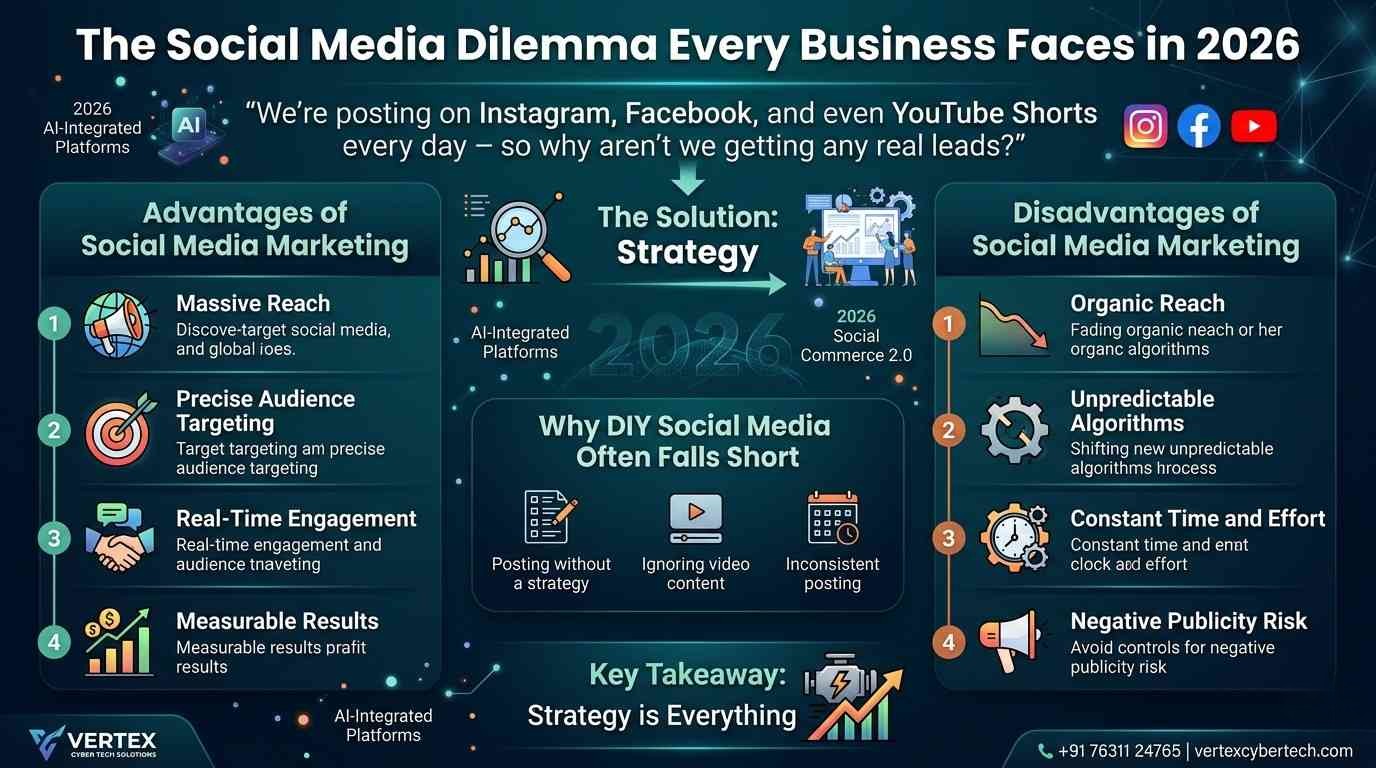
Section 5: Advantages and Disadvantages of Social Media
Marketing
Detailed Comparison Table
|
Advantage |
Description |
Business Implication |
|
1. Extensive Global Reach |
Social media platforms enable engagement with audiences
across the globe |
Access international markets without physical presence |
|
2. Brand Awareness Outlet |
Companies produce and distribute content that raises brand
awareness |
Build recognition before buyers enter evaluation |
|
3. Cost-Effective Advertising |
Frequently more affordable compared to traditional
advertising |
Lower CPL than trade shows ($811) or PPC ($181) |
|
4. Direct Audience Connection |
Direct connection with the audience |
Real-time engagement with technical buyers |
|
5. Brand Loyalty Building |
Improved brand loyalty and advocacy |
81% of B2B buyers purchase from known brands |
|
6. Paid Advertising Access |
Access to paid advertising services |
LinkedIn targeting by job title succeeds for IT |
|
7. Organic Content Creation |
Ability to create organic content |
Content compounds over time like SEO |
|
8. Market Insights |
Audience insights and market research |
Understand technical buyer pain points |
|
9. Competitive Advantage |
Competitive advantage and viral marketing potential |
2.2x ROI for brand fame campaigns |
|
Disadvantage |
Description |
Business Implication |
|
1. Extreme Saturation |
Social media's profusion results in fierce competition |
4,000-10,000 ads bombard users daily |
|
2. Reputation Risks |
Negative publicity spreads quickly |
One bad event can damage brand permanently |
|
3. Time-Consuming |
Maintaining accounts well takes patience and regular work |
Requires dedicated team; 5+ hours/week minimum |
|
4. Algorithm Changes |
Algorithms constantly evolve, impacting organic reach |
Visibility changes without warning; paid required |
|
5. Privacy Issues |
Stricter laws from growing privacy awareness |
Compliance costs increase; targeting limited |
|
6. Measurement Difficulties |
Accurately attributing ROI and conversions challenging |
70% of traffic anonymous; attribution blind |
|
7. Platform Dependence |
Dependence on platforms; control handed to consumers |
Account loss = instant audience loss |
|
8. Slow ROI |
Slow to achieve ROI yet time-consuming |
3-6 months ramp like SEO |
|
9. Attention Capture Difficulty |
Increasingly difficult to capture user attention |
Low CTR: 0.44-0.65% on LinkedIn |
Strategic Recommendations
For IT Companies: Social media works best for
LinkedIn (89% of B2B marketers use it for lead gen). Focus on role-specific
content: technical documentation for CTOs, security compliance for CISOs, ROI
data for CFOs.
Budget Allocation: Allocate 25-35% of paid budget to
LinkedIn for best MQL-to-SQL conversion (14-18%). Use Meta only for retargeting
(5-10%).
Community-Led Growth: The bigger opportunity is
private Slack groups, Discord servers, and industry-specific forums where IT
buyers actually discuss vendor evaluations. This is the "dark social"
channel that attribution can't track but heavily influences purchasing
decisions.
Section 6: Best Digital Marketing Platforms 2026 for
Businesses
Platform Comparison Table
|
Platform |
Best For |
Pricing |
Key Strength |
Limitation |
|
.io |
Email + LinkedIn automation |
$39/month |
AI-powered ICP builder |
Primarily outbound |
|
HubSpot Marketing Hub |
All-in-one inbound |
|||
|
Semrush |
SEO & content strategy |
$139/month |
True all-in-one visibility |
|
|
ActiveCampaign |
Personalized engagement |
$15/month |
||
|
Sprout Social |
Social management |
$199/month |
Strong analytics |
Premium pricing |
|
Zoho Marketing Plus |
Budget-friendly suite |
$30/month |
Learning curve |
|
|
Ahrefs |
Backlink analysis |
$129/month |
Industry-leading SEO data |
High cost |
|
Salesforce Pardot |
Enterprise automation |
$1,250/month |
Salesforce integration |
Overkill for small biz |
Detailed Platform Breakdowns
1. .io
Overview: Lead generation automation tool simplifying
B2B prospecting and outreach
Key Features:
- Email
finder across websites, domains, LinkedIn
- LinkedIn
automation (views, connections, messaging)
- AI
email builder based on ICP
- Multi-step
outreach sequences
- Built-in
CRM + 5,000+ app integrations
Benefits: Combines email and LinkedIn in one
platform; robust AI with ICP generator
Ideal Business Type: B2B companies focused on
outbound lead generation
Pricing Model: Free plan; Paid starts at $39/month
Pros: Multichannel tools; affordable pricing
Cons: Primarily outbound design
2. HubSpot Marketing Hub
Overview: All-in-one inbound marketing platform
unifying campaigns, email, SEO, ads, analytics
Key Features:
- AI-powered
Marketing Studio for campaign planning
- AI
email automation
- Content
tools (blogging, AI video, SEO recommendations)
- Lead
scoring, workflows, social management
- Multi-touch
revenue attribution (Spring 2026)
Benefits: Strong CRM integration; excellent training
resources
Ideal Business Type: Businesses seeking integrated
inbound solution
Pricing Model: Free plan; Starter $15/seat/month; Pro
$890/month; Enterprise $3,600/month
Pros: All-in-one platform; great Academy resources
Cons: Advanced features locked behind high tiers;
costly as contacts grow
3. Semrush
Overview: Online visibility management platform
serving 87,000+ paying customers
Key Features:
- Rank
tracking + daily ranking changes
- AI
writing assistant
- Social
media management + paid ads planning
- SEO,
PPC, content, competitive research combined
Benefits: True all-in-one visibility tool; strong
competitive analysis
Ideal Business Type: Organizations scaling SEO and
content strategy
Pricing Model: Free trial; Paid starts $139/month
Pros: Comprehensive toolkit; market analysis
Cons: Expensive with add-ons; overwhelming interface
4. ActiveCampaign
Overview: Advanced automation platform focused on
customer engagement
Key Features:
- AI-powered
automation with predictive sending
- Cross-channel
(email, SMS, WhatsApp, social ads)
- Advanced
segmentation with behavior tracking
- 950+
integrations
Benefits: Powerful automation; flexible stack
building
Ideal Business Type: Businesses needing personalized
customer journeys
Pricing Model: 14-day trial; Paid starts $15/month
Pros: Predictive AI; extensive integrations
Cons: Complex for beginners; reporting lacks
flexibility
5. Salesforce Pardot
Overview: Marketing automation arm of Salesforce for
robust B2B automation
Key Features:
- Pardot
Einstein AI (lead scoring, behavior scoring, campaign insights)
- Account-based
marketing
- Custom
workflows + Salesforce integration
- Dedicated
IP, developer sandbox (premium)
Benefits: Unmatched sales-marketing alignment
Ideal Business Type: Enterprises with dedicated
marketing teams
Pricing Model: $1,250/month annually for 10,000
contacts
Pros: Advanced AI; Salesforce integration
Cons: Complex setup; overkill for small biz
Selection Framework
Choose based on your needs:
- Option
1: All-in-one CRM + marketing automation → HubSpot or ActiveCampaign
- Option
2: Just marketing automation → Marketo, VBOUT, Pardot, Act-on
- Option
3: Speed up processes → TrueNorth (control panel)
For IT Companies Specifically: .io leads for unified
email + LinkedIn automation with AI-powered ICP targeting. HubSpot excels at
inbound automation. For SEO depth, Semrush leads.
Section 7: Digital Marketing Challenges in the IT Sector
Long Sales Cycles
The average B2B sales cycle runs 379 days. Your prospect
might download a whitepaper in March, attend your webinar in June, request a
demo in September, and finally close in December. Each interaction builds
credibility rather than triggering an immediate purchase.
Solution: Marketing must maintain engagement across
months while providing value at each touchpoint. Email nurture sequences should
educate rather than constantly pitch.
Technical Audiences
IT buyers are more technical and skeptical than almost any
other B2B segment. The CISO cares about your incident response plan. The CTO
wants your API documentation. The CFO wants a payback period calculation.
Solution: Create the Stakeholder Proof Matrix before
launching campaigns:
|
Stakeholder |
Their Fear |
Proof They Need |
Content Format |
|
Security (CISO) |
Data breach, compliance |
SOC 2, pen test results |
|
|
IT (CTO/Director) |
Integration failure |
Architecture docs, API specs |
|
|
Finance (CFO) |
Overspending, poor ROI |
TCO analysis, payback period |
|
|
Operations (VP Ops) |
Disruption |
Implementation timeline |
High Competition
Generic B2B content is everywhere. Technical
content—architecture guides, integration tutorials, security whitepapers,
performance benchmarks—ranks because competitors don't create it.
Solution: Only target topics where you can create
content 3-5x better than the current #1 result.
Attribution Issues
Roughly 70% of your website traffic is anonymous due to
cookie deprecation and privacy tools. IT buying decisions happen in dark
social—private Slack groups, WhatsApp threads—where attribution can't follow.
Solution: Invest in first-party and zero-party
data—email lists, community membership, enrichment data. Every email subscriber
is worth more than 1,000 anonymous visits.
Lead Quality ProblemsYour CMO might celebrate 10,000
webinar registrations, but only 12 turn into pipeline. Average lead-to-customer
conversion across all sources is 0.94%, meaning roughly 1 in 106 captured leads
becomes closed-won revenue.
Solution: Measure pipeline velocity and deal quality,
not lead volume. A campaign generating 50 leads and 8 opportunities is
infinitely more valuable than 500 leads and 2 opportunities.
Section 8: Emerging Trends in IT Marketing for 2026
AI-Driven Personalization
By 2026, B2B technologies leverage AI far beyond basic
chatbots. Modern AI systems analyze thousands of buyer signals
simultaneously—job changes on LinkedIn, technology stack updates, funding
announcements, content consumption patterns—to identify accounts entering
buying cycles before they contact vendors.
Generative AI creates personalized content variations at
scale. A single case study automatically adapts for different industries,
company sizes, and reader roles.
Predictive Analytics
AI-powered platforms predict which accounts are most likely
to convert based on behavioral patterns with 85%+ accuracy. Predictive models
score not just individual leads but entire buying committees.
Marketo's AI-powered (Adobe Sensei) audience segmentation
and predictive intelligence help target the right audience to optimize
conversions.
Zero-Click Search
AI overviews and generative search are reshaping how
technical buyers find information. Your content needs to be structured for
extraction—clear answers, well-organized data, schema markup.
Brand voice is becoming a ranking signal in 2026 SEO.
Voice Search
While not explicitly detailed in research, voice search
continues growing as IT buyers use AI-powered assistants for solution research.
Content should include natural language queries and concise answers.
First-Party Data Strategies
Cookie deprecation combined with IT buyers' technical
sophistication (they run ad blockers and VPNs) means third-party tracking data
is increasingly worthless.
First-party and zero-party data are the gold standard. Build
owned data assets aggressively: registration gates on high-value resources,
interactive tools requiring input, webinar signups.
Marketing Automation
94% of marketers report using generative AI, but most are
still experimenting. The teams pulling ahead integrate AI into specific
workflows—account research, personalized messaging at scale, multichannel
orchestration.
AI Content Optimization
Jasper is AI trained on marketing frameworks for practical
use cases with custom brand voice ensuring consistency. HeyGen speeds up video
content production significantly, helping repurpose SEO content into video
format.
Ahrefs now tracks visits from AI search engines and scores
articles with AI Content Grader.
Section 9: KPIs That Matter for IT Marketing Success
Customer Acquisition Cost (CAC)
Median CAC is $2 for every $1 of new ARR, up 14%
year-over-year. Channel efficiency matters more than ever.
Benchmark: Growth-stage IT companies should target
8-12% of revenue on marketing.
Cost Per Lead (CPL)
|
Channel |
CPL |
|
SEO |
|
|
Email |
|
|
Webinars |
|
|
Content |
|
|
PPC |
|
|
Trade Shows |
Average B2B CPL across all channels: $198.
Marketing Qualified Leads (MQLs)
Average MQL-to-SQL conversion rate: 13%. Top quartile:
25-35%. Industry average: 13-18%. Bottom quartile: Below 8%.
LinkedIn MQL-to-SQL: 14-18%. Google Ads MQL-to-SQL: 7-12%.
Sales Qualified Leads (SQLs)
Average SQL-to-opportunity conversion rate: 24%. Average
opportunity-to-close rate: 21%.
Conversion Rate
Average B2B landing page conversion rate: 2.4%. Median for
B2B SaaS: 2.5–4.0%. Top quartile: 5–8%.
LinkedIn conversion rate (ad click to form fill): 6–11% for
Lead Gen Forms; 1.5–3% for landing page traffic.
Revenue Attribution
Track marketing-sourced revenue as percentage of total company revenue. Calculate return on marketing investment: revenue generated divided by marketing spend.
HubSpot's Marketing Hub Pro+ now includes multi-touch
revenue attribution natively (Spring 2026).
Pipeline Contribution
The model is moving from MQL volume to pipeline
contribution. If your marketing dashboard doesn't show pipeline contribution by
channel, fix that before optimizing anything else.
Track leading indicators:
- Content
engagement scores
- Buying
committee engagement
- Sales
velocity
- Win
rates by marketing source
Section 10: How Vertex Cybertech Helps IT Companies Grow
Vertex Cybertech specializes in helping IT companies
navigate the complex B2B marketing landscape with strategies proven to work for
technical buyers.
Strategic Planning
We start by mapping your buying committee first. The average
B2B tech purchase involves 10-11 stakeholders, and 79% require CFO sign-off.
Each stakeholder needs different proof—our team builds the Stakeholder Proof
Matrix before launching any campaign.
Lead Generation
We invest in SEO and content before anything else. Organic
search delivers leads at $31 CPL versus $181 for PPC and $811 for trade shows.
We pair this with email outreach using verified contact data for faster
pipeline generation while your content engine builds momentum.
Our approach focuses on pipeline contribution, not lead
volume. We measure deal quality and pipeline velocity—because a campaign
generating 50 leads and 8 opportunities beats 500 leads and 2 opportunities.
SEO
We create technical content that ranks because competitors
don't produce it: architecture guides, integration tutorials, security
whitepapers, performance benchmarks. We only target topics where we can create
content 3-5x better than the current #1 result.
Our content is structured for AI overviews and generative
search—clear answers, well-organized data, schema markup—not just traditional
keyword optimization.
Content Marketing
We produce IT-specific content that consistently performs:
- Comparison
pages (your product vs. alternatives)
- Integration
guides
- Security
compliance documentation (SOC 2, ISO 27001)
- "How
we built X" engineering blog posts
- Detailed
case studies with quantified results
- ROI
calculators and business case templates
Performance Marketing
For paid campaigns, we allocate budget strategically:
- Google
Ads: 35-45% for high intent
- LinkedIn:
25-35% for best MQL-to-SQL (14-18%)
- Bing:
15-20% for 253% ROI
- Meta:
5-10% for retargeting only
We run coordinated ABM campaigns to the CTO (technical
proof), CISO (security documentation), CFO (ROI data), and IT Director
(implementation details)—all simultaneously with role-specific messaging.
Analytics
We connect marketing activities to revenue using multi-touch
attribution. You can trace which campaigns, content pieces, and channels
actually influence closed deals rather than guessing based on last-touch
attribution.
Our dashboards show pipeline contribution by channel,
marketing-sourced revenue percentage, customer lifetime value by channel, and
brand awareness metrics.
Ready to transform your IT marketing? Request a
consultation to discuss your specific challenges and build a strategy aligned
with your buying committee's needs.
Article FAQs
What is digital marketing in the IT sector?
Digital marketing in the IT sector refers to strategies technology companies use to promote products/services to other businesses rather than consumers. It operates on longer sales cycles (379 days average), multiple stakeholders (10-11), and rational evaluation criteria.
Why is digital marketing important for IT companies in 2026?
81% of B2B buyers purchase from a brand they already knew on Day 1. With 70% anonymous traffic and 379-day sales cycles, digital marketing maintains engagement while building trust before evaluation begins.
What's the best digital marketing channel for IT companies on a limited budget?
SEO and content marketing at $31 CPL. It has the longest ramp time (3-6 months) but lowest cost per lead and compounds over time. Pair with email outreach using verified data for faster pipeline.
How many stakeholders are in a typical IT purchase?
Research shows 10-11 stakeholders influence the average B2B tech purchase, and 79% require CFO sign-off. Marketing must address each role's concerns with dedicated content.
What are the advantages of social media marketing for IT businesses?
Key advantages include: extensive global reach, cost-effective advertising (vs. $811/trade show CPL), direct audience connection, brand loyalty building, and market insights. LinkedIn delivers 14-18% MQL-to-SQL conversion.
What are the disadvantages of social media marketing?
Major disadvantages include: extreme saturation (4,000-10,000 ads daily), reputation risks, time-consuming management, algorithm changes, privacy issues, measurement difficulties, platform dependence, slow ROI, and low attention capture (0.44-0.65% CTR).
Which digital marketing platform is best for IT companies?
.io leads for unified email + LinkedIn automation with AI-powered ICP targeting. HubSpot excels at inbound automation. For SEO depth, Semrush leads. Choice depends on your specific needs and budget.
What is Account-Based Marketing (ABM) and why does IT need it?
ABM identifies ideal customers and creates personalized campaigns for each account. 81.5% of B2B marketers consider ABM strategic priority—for IT marketing, it's non-negotiable when selling to 10-11 stakeholders per deal.
How long does IT marketing ROI take to appear?
SEO/content: 3-6 months ramp. Email: faster with clean data. Paid media: immediate but doesn't compound. Brand investment shows long-term ROMI (BT Enterprise: GBP 13.52 long-term per GBP 1).
What KPIs matter most for IT marketing success?
Focus on: pipeline contribution by channel, MQL-to-SQL (top quartile: 25-35%), CAC ($2:$1 ARR), CPL by channel, marketing-sourced revenue, customer lifetime value, and ROI.
What's the difference between B2B IT marketing and B2B SaaS marketing?
B2B IT marketing covers full spectrum—managed services, infrastructure, cybersecurity, consulting, hardware—while SaaS focuses on subscription software. IT has longer cycles (379 days), more stakeholders (10-11), heavier compliance (SOC 2, ISO 27001).
What content types drive B2B IT sales?
Case studies with measurable outcomes, technical documentation/architecture guides, industry-specific solution guides, ROI calculators/business case templates, comparison pages, integration guides, security compliance documentation.
How does AI impact IT marketing in 2026?
94% of marketers use generative AI. AI analyzes thousands of buyer signals to identify in-market accounts, creates personalized content at scale, scores buying committees with 85%+ accuracy, and optimizes message timing.
What budget should IT companies allocate to marketing?
Growth-stage: 8-12% of revenue. Mature companies: 5-8%. Pick 2-3 channels based on CPL benchmarks, invest deeply, measure pipeline contribution—not lead volume.
How do I build accurate contact lists for IT buying committees?
Use B2B data platform with 30+ filters (job title, department headcount, technographics, buyer intent). Verify every email before outreach. 7-day refresh cycle keeps contacts current vs. industry 6-week average.
About Vertex Cyber Tech
Vertex Cyber Tech editorial team.