Digital Marketing Agency vs In-House Team: Full Comparison
Agency or in-house? Compare costs, expertise, speed, and flexibility to decide the best digital marketing model for your business growth in 2026.
Digital Marketing Agency vs In-House Team: The Complete 2026 Comparison
It is one of the most consequential decisions a growing business makes: should you hire a digital marketing agency or build your own in-house marketing team? Both paths can deliver exceptional results—and both can fail spectacularly when chosen for the wrong reasons.
This guide cuts through the noise with a structured, honest comparison of every dimension that matters: cost, expertise, speed, flexibility, accountability, and long-term scalability. By the end, you will have a clear framework for making the right decision for your specific business stage, budget, and growth goals.
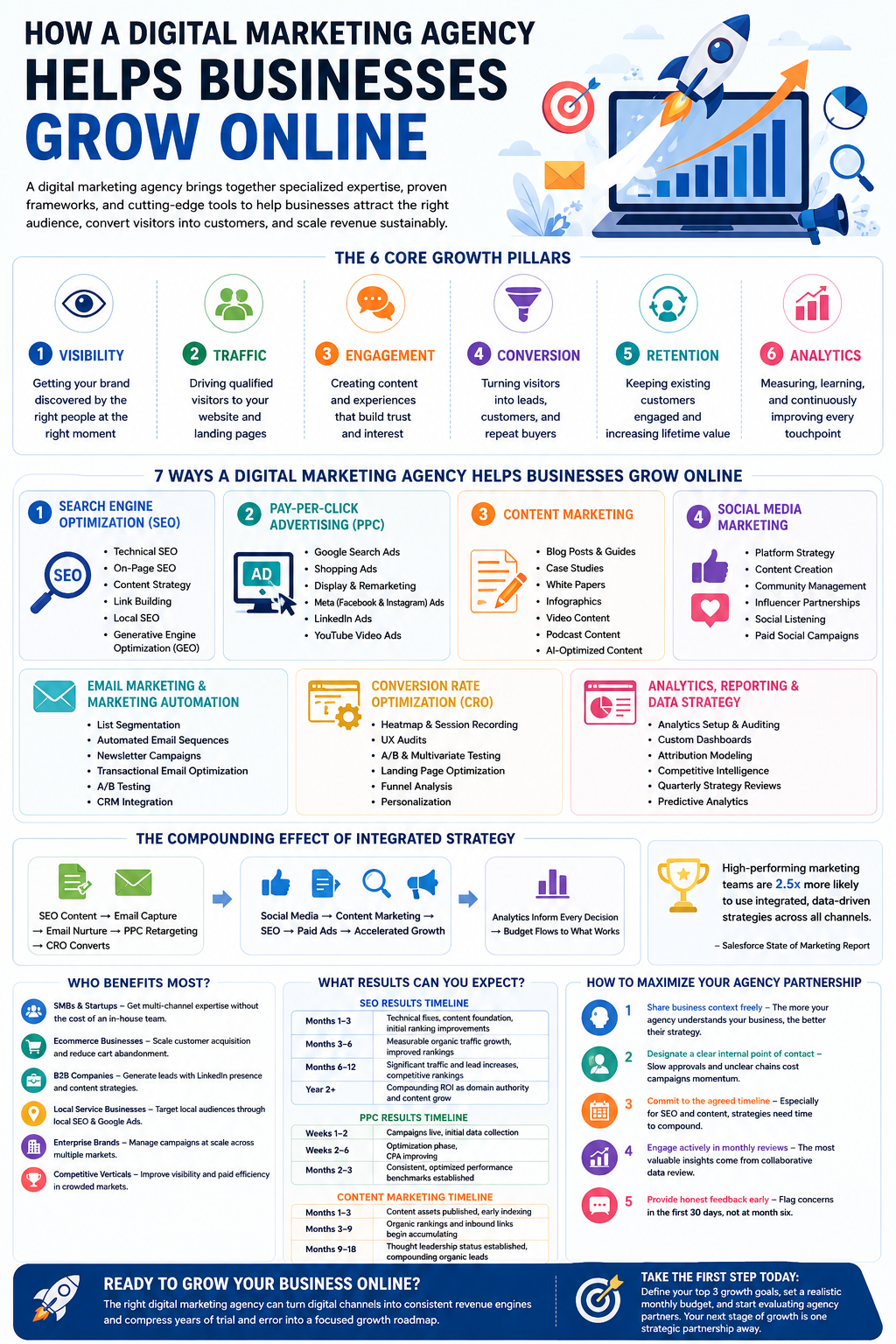
What Is the Core Difference Between an Agency and an In-House Team?
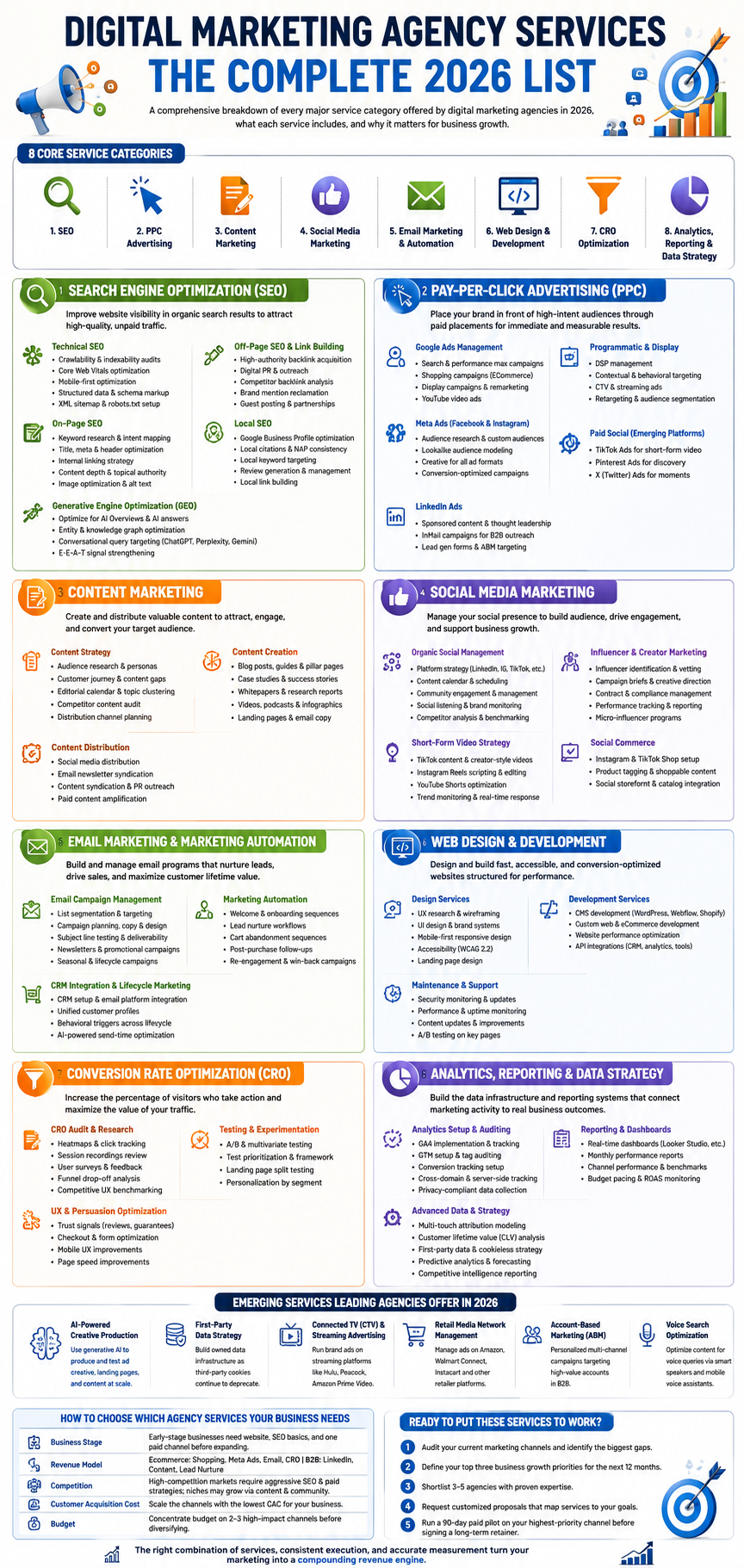
A digital marketing agency is an external service provider that manages some or all of your marketing activities. You pay a monthly retainer or project fee in exchange for access to a team of specialists across SEO, paid media, content, social, analytics, and more.
An in-house marketing team consists of full-time or part-time employees who work exclusively on your brand. They sit inside your organization, participate in company culture, and develop deep institutional knowledge over time.
Neither model is inherently superior. The right choice depends on where your business is today and where you need to go.
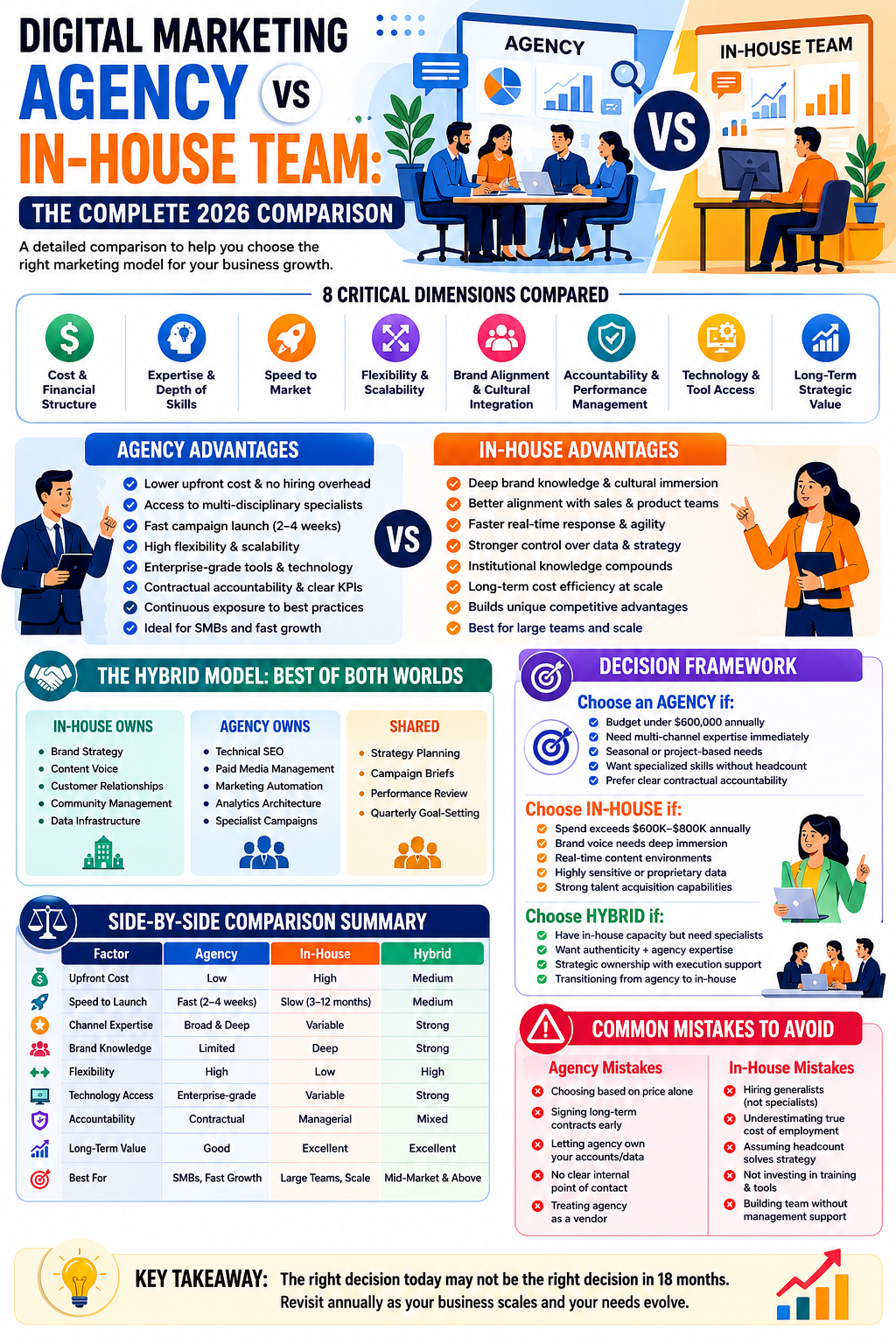
Head-to-Head Comparison: 8 Critical Dimensions
1. Cost and Financial Structure
Cost is typically the first variable businesses examine—and the one most frequently misunderstood.
Agency Cost Structure:
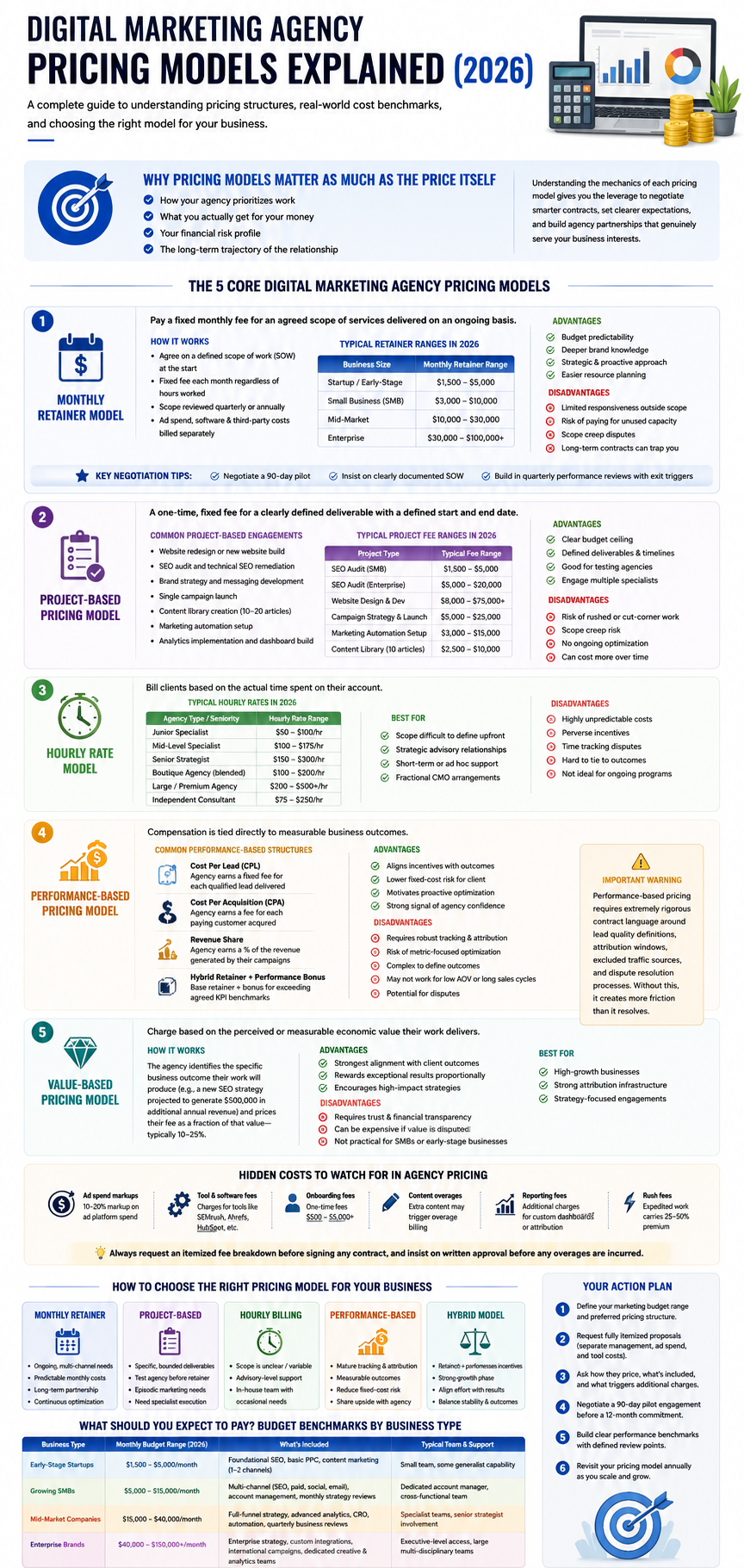
- Monthly retainers typically range from $2,000–$25,000+ depending on scope and market
- No recruitment costs, employee benefits, payroll taxes, or equipment overhead
- Ad spend is billed separately from management fees
- Costs are variable and can be scaled up or down based on business needs
- Onboarding is fast—campaigns can launch within weeks, not months
In-House Team Cost Structure:
- A single mid-level digital marketing manager costs $60,000–$90,000 per year in base salary alone in the US market
- A full in-house team covering SEO, paid media, content, social, and analytics requires 4–6 headcount minimum, representing $300,000–$600,000+ annually in total compensation
- Add recruitment costs ($15,000–$30,000 per hire), benefits (20–30% of salary), software subscriptions ($5,000–$20,000/year), training, and management overhead
- Costs are largely fixed regardless of marketing activity levels
2. Expertise and Depth of Skills
Digital marketing encompasses a wide range of disciplines—technical SEO, performance media buying, UX copywriting, video production, data analytics, marketing automation, and more. Building genuine expertise across all of these in a single organization is extraordinarily difficult.
Agency Expertise Advantages:
- Agencies employ dedicated specialists in each discipline
- Teams work across dozens of client accounts simultaneously
- Agencies invest in ongoing training, certifications, and tool access
- Exposure to cross-industry data identifies opportunities and threats early
In-House Expertise Advantages:
- Deep knowledge of your specific product, customer base, and brand voice
- Institutional memory that compounds over years of employment
- Faster response to business context changes
- Better alignment between marketing messaging and sales reality
3. Speed to Market
Agency: Experienced agencies can launch campaigns within 2–4 weeks of contract signing.
In-House: Building a capable team takes time. Recruiting, interviewing, hiring, and onboarding a single senior hire takes 2–4 months on average.
4. Flexibility and Scalability
Agency Flexibility:
- Scope can expand or contract based on campaign needs
- Access to specialist talent for one-off projects
- Easy strategy pivots when market conditions change
- Rapid resource reallocation based on performance
In-House Flexibility:
- Fixed headcount creates rigidity
- Harder to access niche specialist skills
- More agile for real-time content and community management
5. Brand Alignment and Cultural Integration
In-House Strengths:
- Deep immersion in company culture and values
- Daily proximity to sales, product, and customer service teams
- Faster response to breaking news and social moments
- Direct participation in strategic planning
Agency Limitations:
- Cannot achieve the same depth of brand immersion
- Communication gaps may slow approvals
- Risk of technically strong work lacking authentic voice
- Account manager turnover can impact continuity
6. Accountability and Performance Management
Agency Accountability:
- Contractual performance expectations
- Monthly reporting and defined KPIs
- Clear exit mechanism if results do not materialize
In-House Accountability:
- Direct management oversight
- Long-term employee investment in company success
- More complex HR and employment considerations
7. Technology and Tool Access
Agency Advantages:
- Enterprise-grade tools at shared cost
- Certified platform partnerships
- Access to beta features and support
In-House Advantages:
- Full ownership of tool stack
- Better integration with CRM and BI systems
- No dependency on agency access
8. Long-Term Strategic Value
Agency Long-Term Value:
- Continuous exposure to evolving best practices
- Access to proprietary benchmarks and datasets
- Adaptability to platform and algorithm changes
In-House Long-Term Value:
- Institutional knowledge compounds over time
- Full ownership of data and creative assets
- Development of unique competitive advantages
The Hybrid Model: Best of Both Worlds
The most sophisticated businesses in 2026 don't choose one or the other—they operate a strategic hybrid model that captures the advantages of both.
How the Hybrid Model Typically Works:
- In-house team owns: Brand strategy, content voice, customer relationships, community management, and data infrastructure
- Agency owns: Technical SEO, paid media management, marketing automation, analytics architecture, and specialist campaign execution
- Shared: Strategy planning, campaign briefs, performance review, and quarterly goal-setting
According to Gartner's CMO Spend Survey, nearly 60% of enterprise marketing leaders now operate some form of hybrid agency and in-house model—up significantly from just 35% five years ago.
Decision Framework: Which Model Is Right for Your Business?
Choose an Agency If:
- Your annual marketing budget is under $600,000
- You need multi-channel expertise immediately
- Your marketing needs are seasonal or project-based
- You want access to specialized skills without full-time headcount
- You want clear contractual accountability
Choose In-House If:
- Your marketing spend exceeds $600,000–$800,000 annually
- Your brand voice requires deep cultural immersion
- You operate in real-time content environments
- You handle highly sensitive data
- You have strong talent acquisition capabilities
Choose a Hybrid Model If:
- You have established in-house capacity but need specialist expertise
- You want to maintain cultural authenticity while scaling
- You want strategic ownership with outsourced execution
- You are transitioning toward a larger internal team
Common Mistakes to Avoid in Both Models
Agency Model Mistakes
- Choosing an agency based on price alone
- Signing long-term contracts before testing a pilot engagement
- Allowing agencies to retain ownership of your data
- Failing to assign a clear internal point of contact
- Treating the agency as a vendor instead of a partner
In-House Model Mistakes
- Hiring generalists when specialists are required
- Underestimating the true cost of employment
- Assuming headcount solves strategic problems
- Failing to invest in training and technology
- Building a team without management infrastructure
A Side-by-Side Comparison Summary
| Factor | Agency | In-House | Hybrid |
|---|---|---|---|
| Upfront Cost | Low | High | Medium |
| Speed to Launch | Fast (2–4 weeks) | Slow (3–12 months) | Medium |
| Channel Expertise | Broad and Deep | Variable | Strong |
| Brand Knowledge | Limited | Deep | Strong |
| Flexibility | High | Low | High |
| Technology Access | Enterprise-grade | Variable | Strong |
| Accountability | Contractual | Managerial | Mixed |
| Long-Term Value | Good | Excellent | Excellent |
| Best For | SMBs, Fast Growth | Large Teams, Scale | Mid-Market and Above |
Make the Right Choice for Your Business Growth
There is no universally correct answer to the agency versus in-house debate. The right model depends entirely on your budget, growth stage, marketing complexity, and strategic priorities.
What is clear is this: the businesses that grow fastest are those that make a deliberate, well-informed choice—and then execute it with commitment.
If you are ready to evaluate your options:
- Map your current marketing budget against the true cost of each model
- Audit the specific channel expertise your growth strategy requires
- Assess your internal capacity to manage and support either model effectively
- Run a 90-day paid agency pilot before making any long-term commitments
- Revisit the decision annually as your business scales and your needs evolve
The right decision today may not be the right decision in 18 months—and the most successful marketing leaders treat this as an ongoing strategic question, not a one-time choice.
Article Highlights
Core Differences: Agency vs In-House at a Glance
A digital marketing agency provides external specialist teams on a retainer or project basis, while an in-house team consists of full-time employees embedded inside your organization. Agencies offer breadth, speed, and flexibility; in-house teams offer brand depth, cultural alignment, and institutional knowledge. Neither is universally superior—the right choice depends on your business stage, budget, and growth requirements.
Cost Comparison: What You Actually Pay for Each Model
Agency retainers range from $2,000–$25,000+ per month with no recruitment, benefits, or equipment costs. A full in-house team capable of multi-channel execution typically costs $300,000–$600,000+ annually in total compensation alone. For businesses spending under $50,000 per month on marketing, agencies consistently deliver more capability per dollar invested.
Expertise, Speed, and Flexibility: Where Each Model Wins
Agencies win on specialist depth, speed to market (campaigns can launch in 2–4 weeks), cross-industry insight, and structural flexibility to scale up or down. In-house teams win on brand authenticity, operational agility for real-time content, and deep customer knowledge accumulated over years of direct engagement.
The Hybrid Model: Combining Agency and In-House Strengths
The most effective approach for mid-market and enterprise businesses in 2026 is a hybrid model: in-house teams own brand strategy, voice, and community management, while agency partners handle technical SEO, paid media, analytics architecture, and specialist campaign execution. Nearly 60% of enterprise marketing leaders now operate some form of this hybrid structure, according to Gartner.
Decision Framework and CTA: Choosing the Right Model for Your Business
Choose an agency if your budget is under $600,000 annually or you need rapid multi-channel capability. Choose in-house if your spend justifies headcount and your brand requires deep cultural immersion. Choose a hybrid model if you need both strategic authenticity and specialist execution. Audit your budget, map required channel expertise, and run a 90-day agency pilot before committing to any long-term structure.
Article FAQs
Is it cheaper to hire a digital marketing agency or build an in-house team?
For most businesses, a digital marketing agency is significantly cheaper than building an equivalent in-house team. A full in-house team covering SEO, paid media, content, social, and analytics requires 4–6 specialists at a total annual cost of $300,000–$600,000+ including salary, benefits, recruitment, and tools. A capable agency retainer covering the same scope typically costs $24,000–$120,000 per year. The cost calculation flips for large enterprises with marketing budgets exceeding $50,000 per month, where in-house headcount often delivers better long-term ROI.
What are the main advantages of hiring a digital marketing agency over an in-house team?
The main advantages of hiring a digital marketing agency include immediate access to a full team of channel specialists without recruitment delays, lower total cost for SMBs, enterprise-grade tools shared across client accounts, cross-industry performance data that in-house teams can't access, and structural flexibility to scale campaigns up or down based on business needs. Agencies also launch campaigns 3–5x faster than the time required to hire and onboard equivalent in-house talent.
What are the main advantages of an in-house marketing team over an agency?
In-house marketing teams excel at brand authenticity, cultural alignment, and deep institutional knowledge. Because they work exclusively on your brand, they develop an understanding of your customers, competitive nuances, and company voice that external agencies struggle to replicate. In-house teams are also faster for real-time reactive content, tighter integration with sales and product teams, and the accumulation of proprietary data and creative assets that become long-term competitive advantages.
What is a hybrid marketing model and when should a business use it?
A hybrid marketing model combines an in-house team with one or more agency partners, with each side handling the functions where they excel most. Typically, in-house teams own brand strategy, content voice, community management, and data infrastructure, while agencies manage technical SEO, paid media, analytics architecture, and specialist campaign execution. Businesses should consider a hybrid model when they have established internal marketing capacity but need specialized channel expertise, or when scaling from an agency-only setup toward full in-house capability.
How do I decide between a digital marketing agency and an in-house team?
The decision comes down to four variables: budget, speed, expertise requirements, and brand complexity. If your annual marketing budget is under $600,000, you need multi-channel expertise quickly, or your marketing needs are seasonal, an agency typically wins on value. If your budget exceeds $600,000–$800,000, your brand requires deep cultural immersion, or you handle highly sensitive data, in-house becomes competitive. Most businesses benefit from running a structured comparison using total cost, required skill sets, and time-to-market as the primary decision criteria.
Can a small business afford a digital marketing agency?
Yes. Many digital marketing agencies offer service packages starting at $2,000–$3,000 per month tailored to small business budgets. At this investment level, a small business gains access to a team of 3–5 specialists—something impossible to replicate with even a single in-house hire at comparable cost. The key is matching agency scope to actual business needs rather than purchasing a full-service retainer before the business is ready to utilize all channels effectively.
What happens to marketing knowledge if I switch from an agency to an in-house team?
Transitioning from agency to in-house carries real knowledge transfer risk. To protect your business during this transition, ensure your agency contract specifies that you retain full ownership of all ad accounts, creative assets, website assets, analytics configurations, and campaign documentation from day one. Request comprehensive handover documentation covering strategy rationale, campaign structures, audience configurations, and keyword research. Plan a parallel operation period of 30–60 days where the agency and new in-house team work simultaneously before the full transition.
How many people do you need for an effective in-house digital marketing team?
An effective in-house digital marketing team typically requires a minimum of 4–6 specialists to cover all core channels: an SEO strategist, a paid media manager, a content marketer, a social media manager, a marketing analyst, and a marketing manager or director to lead the function. Smaller businesses often start with 2–3 generalists and add specialists as budget and complexity grow. Each specialist role typically costs $60,000–$100,000+ annually in total compensation in major markets.
Do agencies or in-house teams perform better for SEO?
Specialist SEO agencies typically outperform in-house teams on technical SEO execution due to deeper expertise, cross-client data, and continuous exposure to algorithm updates across many websites. However, in-house teams often produce better content SEO because they have deeper product knowledge, subject matter access, and brand voice authenticity. The optimal approach for most scaling businesses is to work with an SEO agency for technical strategy and link building while building in-house content capability for ongoing publishing.
What are the biggest risks of choosing a digital marketing agency over an in-house team?
The main risks of the agency model include account manager turnover disrupting brand continuity, misaligned incentives if agency fees aren't tied to business outcomes, potential lack of brand voice authenticity in content production, and dependency on an external partner for critical marketing functions. These risks are manageable with strong contracts that include performance clauses, clear ownership terms for all accounts and assets, defined communication protocols, and regular strategic alignment reviews between agency and internal stakeholders.
About Vertex Cyber Tech
Vertex Cyber Tech editorial team.