Digital Marketing Agency Pricing Models Explained (2026)
Understand every digital marketing agency pricing model in 2026—retainers, project fees, hourly rates, and performance-based structures—to budget smarter and negotiate better.
Digital Marketing Agency Pricing Models Explained (2026)
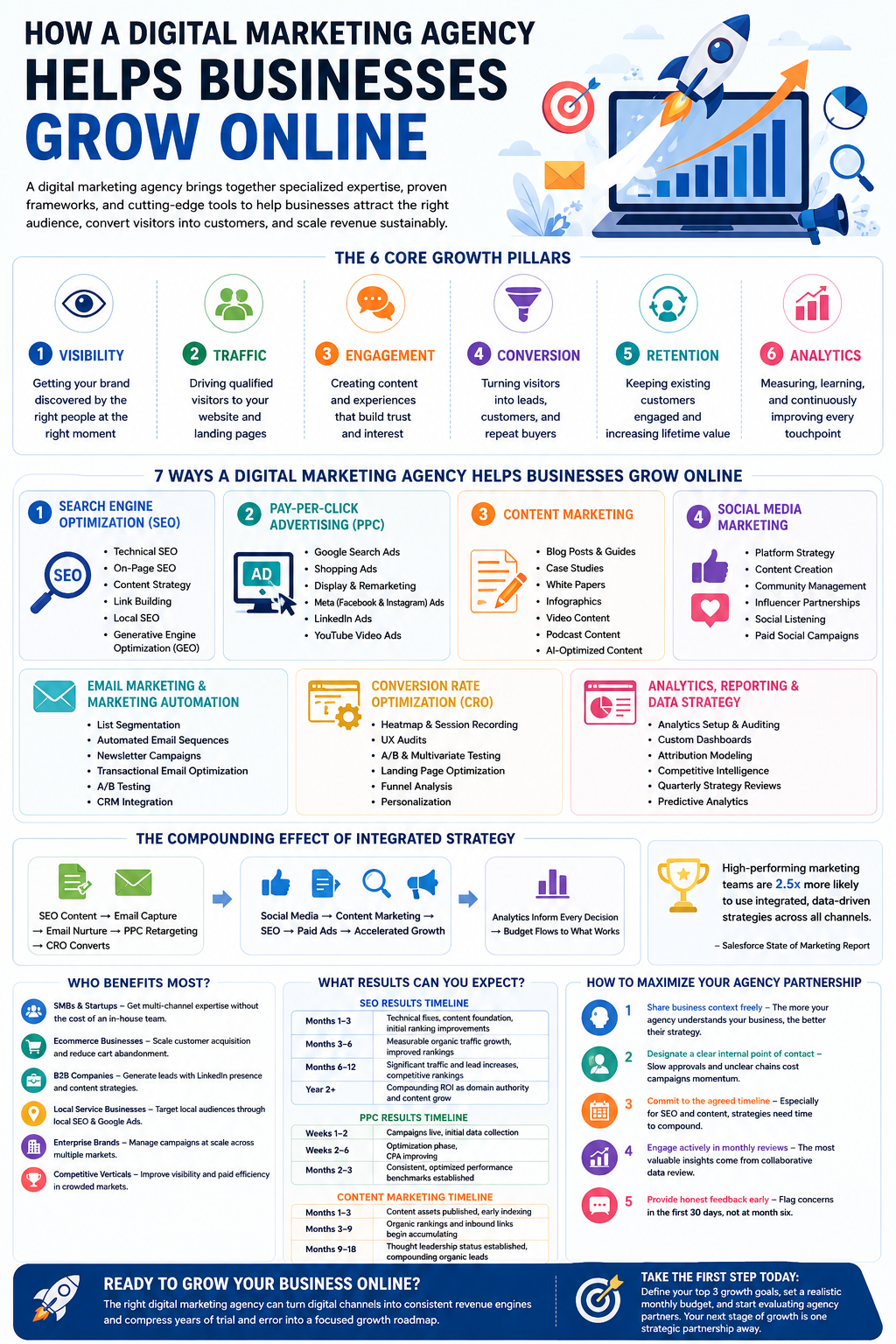
One of the most common sources of confusion when hiring a digital marketing agency is understanding how they charge for their services. Pricing structures vary significantly across agencies, service types, and business models—and choosing the wrong pricing arrangement can cost you thousands of dollars or misalign your incentives from day one.
This guide breaks down every major digital marketing agency pricing model in plain language, with real-world cost benchmarks, the pros and cons of each structure, and a practical framework for choosing the model that fits your business best.
Why Pricing Models Matter as Much as the Price Itself
Most businesses focus exclusively on the number in a proposal—the monthly fee or project cost—without evaluating the underlying pricing structure. This is a mistake. The model determines:
- How your agency prioritizes work: A performance-based agency behaves very differently from one on a flat retainer.
- What you actually get for your money: Hourly billing creates different incentives than outcome-based pricing.
- Your financial risk profile: Some models protect you from overpaying; others expose you to runaway costs.
- The long-term trajectory of the relationship: Misaligned pricing creates friction, resentment, and churn.
Understanding the mechanics of each pricing model gives you the leverage to negotiate smarter contracts, set clearer expectations, and build agency partnerships that genuinely serve your business interests.
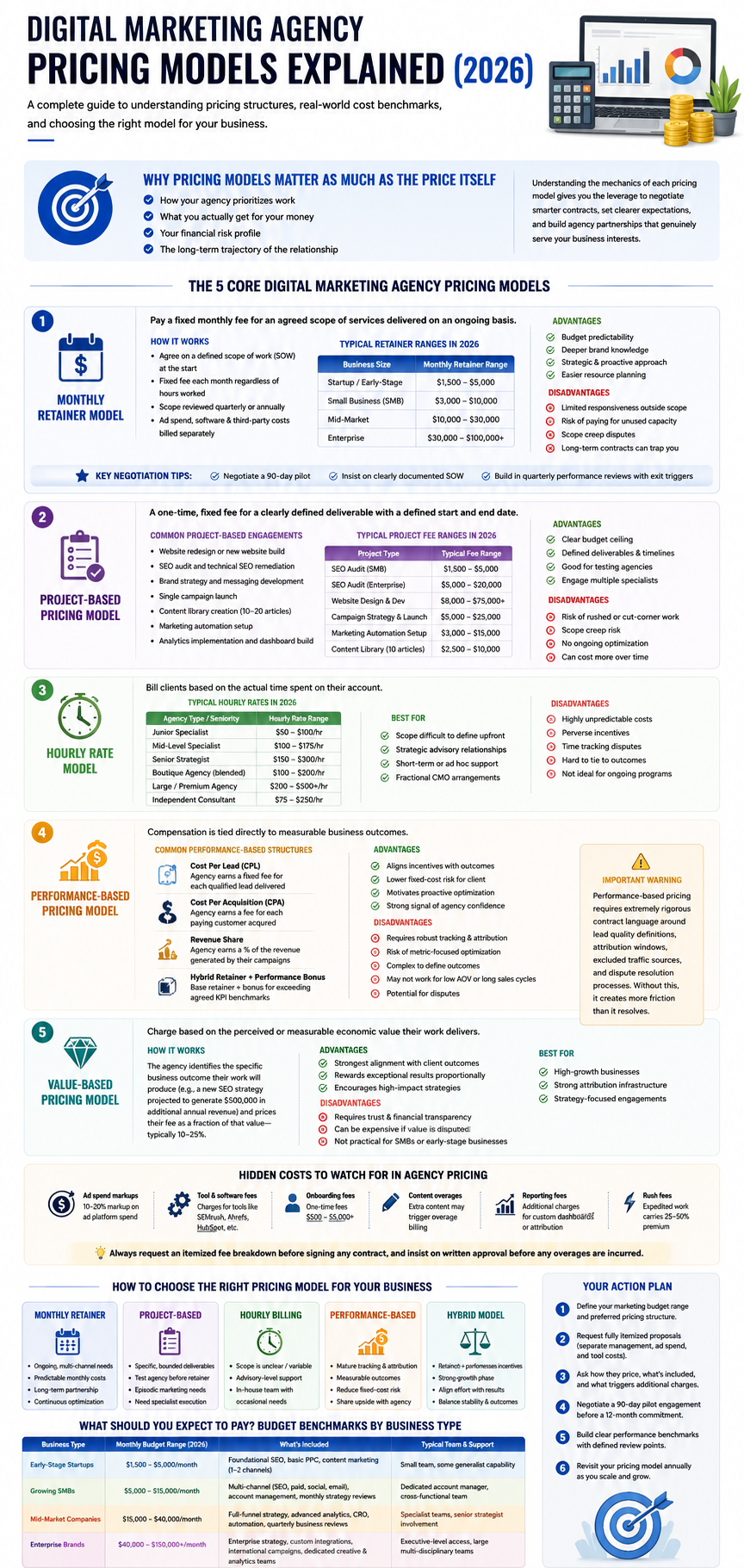
The 5 Core Digital Marketing Agency Pricing Models
1. Monthly Retainer Model
The monthly retainer is the most common pricing structure in the digital marketing industry. Under this model, you pay a fixed monthly fee in exchange for an agreed scope of services delivered on an ongoing basis.
How it works:
- Agency and client agree on a defined scope of work (SOW) at the start of the engagement.
- Client pays a fixed fee each month regardless of hours worked.
- Scope is typically reviewed and renegotiated quarterly or annually.
- Ad spend, software subscriptions, and third-party costs are usually billed separately on top of the retainer.
Typical Retainer Ranges in 2026:
| Business Size | Monthly Retainer Range |
|---|---|
| Startup / Early-Stage | $1,500 – $5,000 |
| Small Business (SMB) | $3,000 – $10,000 |
| Mid-Market | $10,000 – $30,000 |
| Enterprise | $30,000 – $100,000+ |
Best for:
- Businesses with ongoing, multi-channel marketing needs
- Companies that want predictable monthly marketing costs
- Brands that value a long-term strategic partnership over transactional project work
Advantages:
- Budget predictability for both parties
- Agency builds deep knowledge of your brand over time
- Encourages proactive, strategic thinking rather than just task execution
- Easier to plan resource allocation and campaign momentum
Disadvantages:
- Fixed scope can limit responsiveness to urgent needs outside the agreed deliverables
- Risk of paying for capacity you don't fully utilize in slower months
- Requires clear SOW documentation to prevent scope creep disputes
- Long-term contracts can trap you with an underperforming agency
- Negotiate a 90-day pilot before a long-term contract.
- Document all deliverables clearly in the SOW.
- Schedule quarterly performance reviews with exit clauses.
2. Project-Based Pricing Model
Project-based pricing involves a one-time, fixed fee for a clearly defined deliverable with a defined start and end date.
Common Project-Based Engagements:
- Website redesign or new website build
- SEO audit and technical SEO remediation
- Brand strategy and messaging development
- Single campaign launch
- Content library creation
- Marketing automation setup
- Analytics implementation and dashboard build
| Project Type | Typical Fee Range |
|---|---|
| SEO Audit (SMB) | $1,500 – $5,000 |
| SEO Audit (Enterprise) | $5,000 – $20,000 |
| Website Design & Development | $8,000 – $75,000+ |
| Campaign Strategy and Launch | $5,000 – $25,000 |
| Marketing Automation Setup | $3,000 – $15,000 |
| Content Library (10 articles) | $2,500 – $10,000 |
Best for:
- Specific, well-defined marketing needs
- Testing agency capabilities
- Fixed-budget initiatives
Advantages:
- Clear budget ceiling
- Defined deliverables and timelines
- Good for agency evaluation
- Supports specialist agency engagements
Disadvantages:
- Risk of rushed work
- Scope creep issues
- No ongoing optimization
- Can become expensive over time
3. Hourly Rate Model
The hourly rate model bills clients based on the actual time spent on their account.
| Agency Type / Seniority | Hourly Rate Range |
|---|---|
| Junior Specialist | $50 – $100/hr |
| Mid-Level Specialist | $100 – $175/hr |
| Senior Strategist | $150 – $300/hr |
| Boutique Agency | $100 – $200/hr |
| Large / Premium Agency | $200 – $500+/hr |
| Independent Consultant | $75 – $250/hr |
4. Performance-Based Pricing Model
Performance-based pricing ties agency compensation directly to measurable business outcomes.
Common Structures:
- Cost Per Lead (CPL)
- Cost Per Acquisition (CPA)
- Revenue Share
- Hybrid Retainer + Performance Bonus
5. Value-Based Pricing Model
Value-based pricing charges based on the measurable business value delivered to the client rather than time or effort.
Hidden Costs to Watch for in Agency Pricing
- Ad spend markups
- Tool and software fees
- Onboarding or setup fees
- Content production overages
- Reporting and analytics fees
- Rush fees
How to Choose the Right Pricing Model for Your Business
Choose a Monthly Retainer If:
- You need ongoing, multi-channel marketing support
- You want predictable monthly costs
- You are building a long-term agency partnership
Choose Project-Based Pricing If:
- You have a specific deliverable
- You want to test an agency first
- Your marketing needs are not continuous
Choose Hourly Billing If:
- Your scope is unclear and variable
- You need advisory support
- You have an internal team already
Choose Performance-Based Pricing If:
- You have mature attribution tracking
- You can define measurable outcomes
- You want lower fixed costs
Choose a Hybrid Model If:
- You want retainer stability and performance incentives
- You are scaling rapidly
- You want outcome alignment
What Should You Expect to Pay? Budget Benchmarks by Business Type
- Early-Stage Startups ($1,500–$5,000/month): Foundational SEO, PPC, and content marketing.
- Growing SMBs ($5,000–$15,000/month): Multi-channel execution and account management.
- Mid-Market Companies ($15,000–$40,000/month): Full-funnel strategy, analytics, CRO, and automation.
- Enterprise Brands ($40,000–$150,000+/month): International campaigns and enterprise-grade support.
Ready to Find an Agency That Prices Fairly and Performs?
Understanding pricing models is the foundation of a successful agency relationship—but it is only the starting point.
Your Action Plan:
- Define your marketing budget range and preferred pricing structure.
- Request itemized proposals.
- Clarify all fees and overage triggers.
- Negotiate a 90-day pilot engagement.
- Build performance benchmarks into the contract.
- Review pricing annually as your business grows.
The best agency partnerships are built on pricing transparency, aligned incentives, and mutual accountability.
Article Highlights
The 5 Core Digital Marketing Agency Pricing Models
Digital marketing agencies price their services using five primary models: monthly retainer (fixed ongoing fee for a defined scope), project-based pricing (one-time fee for a specific deliverable), hourly billing (time-tracked charges), performance-based pricing (fees tied to measurable outcomes like leads or revenue), and value-based pricing (fees calculated as a fraction of the economic value delivered). Each model creates different incentive structures and suits different business situations.
Monthly Retainer vs Project-Based: Which Is Right for You?
Monthly retainers suit businesses with ongoing multi-channel marketing needs, offering budget predictability and strategic continuity typically ranging from $1,500 to $100,000+ per month depending on business size. Project-based pricing works best for discrete deliverables like website builds, SEO audits, or campaign launches, with clear cost ceilings and defined timelines. The right choice depends on whether your marketing needs are continuous or episodic.
Performance-Based and Value-Based Pricing: High Risk, High Alignment
Performance-based pricing ties agency fees to measurable outcomes such as cost per lead, cost per acquisition, or revenue share—creating strong incentive alignment but requiring robust conversion tracking infrastructure and carefully drafted contracts. Value-based pricing charges a fraction of the measurable economic value delivered and is used primarily by premium boutique agencies for high-growth clients. Both models demand mature attribution capabilities and transparent data sharing to function fairly.
Hidden Costs and What to Watch for in Agency Contracts
Beyond the headline fee, agency contracts often include ad spend markups (10–20% on top of actual platform costs), tool and software pass-through fees, onboarding or setup charges, content production overages, rush fees, and separate analytics or reporting costs. Always request fully itemized proposals and require written approval before any overage costs are incurred. Understanding the full cost structure prevents budget surprises and protects your return on investment.
Pricing Decision Framework and CTA: Choosing Your Model
Select a monthly retainer for ongoing multi-channel support; project-based pricing for bounded deliverables; hourly billing for flexible advisory needs; performance-based for outcome-aligned lead or revenue generation; and hybrid retainer-plus-performance for growth-stage businesses wanting base stability with results incentives. Define your budget range, request itemized proposals, negotiate a 90-day pilot, and build performance benchmarks into every contract before signing.
Article FAQs
What are the main digital marketing agency pricing models?
The five main digital marketing agency pricing models are: monthly retainer (fixed ongoing fee for a defined scope of services), project-based pricing (one-time fee for a specific deliverable), hourly billing (time-tracked charges based on actual hours worked), performance-based pricing (fees tied to measurable results like leads, conversions, or revenue), and value-based pricing (fees calculated as a percentage of the measurable economic value the agency's work creates). Many agencies also offer hybrid structures combining a base retainer with performance bonuses.
How much does a digital marketing agency charge per month?
Digital marketing agency monthly retainers in 2026 typically range from $1,500–$5,000 per month for startups and early-stage businesses, $3,000–$10,000 for small businesses, $10,000–$30,000 for mid-market companies, and $30,000–$100,000+ for enterprise brands. These fees cover agency management and strategy; advertising spend on platforms like Google Ads and Meta is almost always billed separately on top of the management retainer.
What is a performance-based digital marketing agency pricing model?
A performance-based pricing model ties agency compensation to measurable business outcomes rather than fixed fees or hours worked. Common structures include cost per lead (agency earns a fixed fee per qualified lead), cost per acquisition (fee per paying customer), and revenue share (agency earns a percentage of revenue—typically 5–15%—attributed to their campaigns). This model aligns agency incentives with client outcomes but requires robust conversion tracking infrastructure and carefully defined contract terms to prevent disputes over attribution and lead quality.
Is a monthly retainer or project-based pricing better for my business?
A monthly retainer is better if you need continuous, multi-channel marketing support, value budget predictability, and want to build a long-term strategic agency partnership. Project-based pricing is better if you have a specific, bounded deliverable with a clear end date—such as a website redesign, SEO audit, or product launch campaign—or if you want to test an agency's capabilities before committing to ongoing work. Many businesses start with a project engagement to evaluate the agency and then transition to a retainer once trust is established.
What hidden costs should I watch for in a digital marketing agency contract?
Common hidden costs in agency contracts include ad spend markups of 10–20% added on top of your actual platform advertising costs, software and tool subscription pass-through fees (SEMrush, Ahrefs, HubSpot licenses), one-time onboarding or setup fees ranging from $500 to $5,000, content production overages when monthly deliverable volumes are exceeded, rush fees for expedited turnarounds, and separate charges for custom analytics dashboards or advanced attribution setup. Always request a fully itemized proposal that separates every cost category before signing.
What is a value-based digital marketing agency pricing model?
Value-based pricing is a model where an agency charges based on the measurable economic value their work delivers to the client, rather than on time, scope, or performance metrics. For example, if an SEO strategy is projected to generate $500,000 in additional annual revenue, the agency might charge 10–20% of that created value. This model creates the strongest alignment between agency effort and client business outcomes but requires mature revenue attribution infrastructure, mutual trust, and transparent financial data sharing to work effectively. It is most common among premium boutique agencies and specialist strategic consultancies.
How do digital marketing agencies charge for advertising spend?
Most digital marketing agencies charge for advertising spend in one of two ways: either the client funds their own ad accounts directly (preferred, as you retain control and visibility), with the agency charging a separate management fee; or the agency bills advertising spend through their own accounts and invoices the client, sometimes with a 10–20% markup. Always insist on owning and funding your own ad accounts directly to maintain data ownership, avoid markups, and protect your campaign history if the agency relationship ends.
What is a hybrid digital marketing agency pricing model?
A hybrid pricing model combines a base monthly retainer with a performance-based bonus component. The retainer covers the agency's fixed operating costs and baseline service delivery, while the performance bonus is triggered when the agency exceeds agreed KPIs—such as revenue targets, lead volume thresholds, or ROAS benchmarks. This structure is increasingly popular because it provides clients with budget predictability while giving agencies a meaningful incentive to maximize results beyond minimum contractual obligations. It is generally considered the most balanced model for growth-stage and mid-market businesses.
Should I negotiate a pilot engagement before signing a long-term agency contract?
Yes—a 90-day paid pilot engagement is strongly recommended before committing to a 12-month retainer. A pilot allows you to evaluate the agency's actual work quality, communication style, reporting transparency, and strategic thinking with limited financial exposure. During the pilot, define specific deliverables and KPIs, establish reporting cadence, and assess whether the team assigned to your account matches the senior talent who pitched you. Use pilot performance data to negotiate more favorable long-term terms or to eliminate an underperforming agency before significant funds are committed.
What pricing model do most digital marketing agencies use?
The monthly retainer is the most widely used pricing model across the digital marketing agency industry, favored by both agencies and clients for its predictability, scope clarity, and support for long-term strategic relationships. Project-based pricing is the second most common, particularly for website development and campaign-specific work. According to HubSpot's Agency Pricing Report, the fastest-growing model is the hybrid retainer-plus-performance structure, which has seen rapid adoption as both parties seek stronger outcome alignment alongside financial stability.
About Vertex Cyber Tech
Vertex Cyber Tech editorial team.