Digital Marketing Agency Case Study: From Stagnant to 312% Revenue Growth
Explore a real-world digital marketing agency case study showing how an integrated SEO, PPC, and content strategy drove 312% revenue growth in 14 months.
Digital Marketing Agency Case Study: How an Integrated Campaign Delivered 312% Revenue Growth in 14 Months
Case studies are the most credible proof point in digital marketing. They cut through the noise of promises and proposals, showing exactly what a strategic agency partnership looks like when it works—and precisely why it works.
This case study documents a complete digital marketing campaign executed for a mid-market B2C ecommerce business, from initial audit through full-funnel execution to measurable business outcomes.
Every strategy, decision, and result documented here reflects the kind of rigorous, integrated approach that separates transformational agency partnerships from expensive disappointments.
Client Background: The Business Before the Campaign
Company: NovaSkin Co. (name changed for confidentiality)
Industry: Direct-to-consumer skincare and wellness ecommerce
Business Model: Online-only DTC brand selling premium skincare products at $45–$120 average order value
Annual Revenue at Engagement Start: $1.2 million
Monthly Marketing Spend: $18,000 (including ad spend)
Team Size: 11 employees, no dedicated in-house marketer
The Situation When the Agency Was Hired
NovaSkin Co. had been operating for three years with solid product-market fit—strong repeat purchase rates and positive customer reviews—but had hit a growth ceiling.
Their revenue had been essentially flat for 18 months. They were running Google Ads campaigns internally with no formal strategy, their website had not been touched in over two years, and their organic search traffic was minimal. Social media was active but generating almost no revenue.
Phase 1: Discovery and Audit (Weeks 1–4)
Before any strategy was proposed or a single campaign modified, the agency conducted a comprehensive four-week discovery and audit process.
What the Audit Revealed
Technical SEO Audit
- Website Core Web Vitals were failing across all metrics—Largest Contentful Paint (LCP) averaging 6.2 seconds on mobile
- 47 pages returning 404 errors due to a previous website migration
- No structured data or schema markup implemented
- 312 duplicate content issues across product and category pages
- Zero blog content—no organic content presence despite three years of operation
Paid Advertising Audit
- Google Ads account had 23 active campaigns with no clear structure or naming convention
- Average Quality Score across campaigns: 4.2 out of 10
- Shopping campaigns had no negative keyword lists
- No conversion tracking for purchases
- No remarketing campaigns running despite significant website traffic
Analytics and Tracking Audit
- GA4 was not properly configured
- No attribution model defined
- Email list of 14,000 subscribers with zero automated sequences beyond a basic welcome email
Competitive Landscape Analysis
- Three direct competitors were dominating organic search
- Competitors were running highly structured Google Shopping campaigns
- The highest-traffic competitor was capturing 68% of organic clicks
The Diagnosis
The core problem was not the product, the brand, or the market. It was a foundational absence of marketing infrastructure.
Phase 2: Strategy Development (Weeks 3–5)
Workstream 1: Foundation Fixes (Months 1–3)
- Rebuild GA4 ecommerce tracking
- Resolve all 404 errors and redirects
- Improve Core Web Vitals
- Restructure Google Ads account
- Implement transaction-level conversion tracking
- Launch optimized Shopping campaigns
Workstream 2: Organic Growth Engine (Months 2–14)
- Target 45 high-intent commercial keywords
- Publish two SEO-optimized blog posts weekly
- Build topical authority clusters
- Execute digital PR campaigns
- Optimize product and category pages
Workstream 3: Revenue Acceleration (Months 1–14)
- Restructure Google Ads campaigns
- Launch Google Shopping campaigns
- Build full remarketing stack
- Develop six-sequence email automation architecture
- Launch Meta Ads prospecting campaigns
Phase 3: Execution and Month-by-Month Results
Months 1–3: Foundation and Early Signals
Technical Work Completed
- All 404 errors resolved
- LCP reduced from 6.2s to 1.9s
- GA4 ecommerce tracking implemented
- Google Ads account rebuilt
- Shopping campaigns launched
- Email automations deployed
Early Results (Month 3 vs Baseline)
- Organic traffic: +18%
- Google Ads ROAS: 1.8x → 3.1x
- Email revenue: +$8,400/month
- Shopping campaigns: 22% of paid revenue
Months 4–8: Content Momentum and Paid Scaling
Content Production Milestones
- 38 SEO-optimized blog posts published
- 6 pillar content pages built
- 14 DR50+ backlinks acquired
- Domain Rating improved from DR22 to DR38
Month 8 Results vs Baseline
- Organic traffic: +187%
- Organic revenue contribution: 28%
- Blended ROAS: 4.4x
- Monthly revenue: $186,000
- Email revenue: $24,000/month
Months 9–14: Compounding Returns and Full-Funnel Optimization
CRO Interventions
- A/B tested product pages
- Simplified checkout flow
- Implemented social proof modules
- Optimized mobile UX
SEO Performance at Month 14
- 94 blog posts published
- 31 keywords ranking on Page 1
- 7 keywords ranking in Positions 1–3
- Organic search contributing 41% of revenue
- Domain Rating: DR51
- 47 referring domains acquired
Final Results: 14-Month Campaign Outcomes
Revenue and ROI
| Metric | Baseline | Month 14 | Change |
|---|---|---|---|
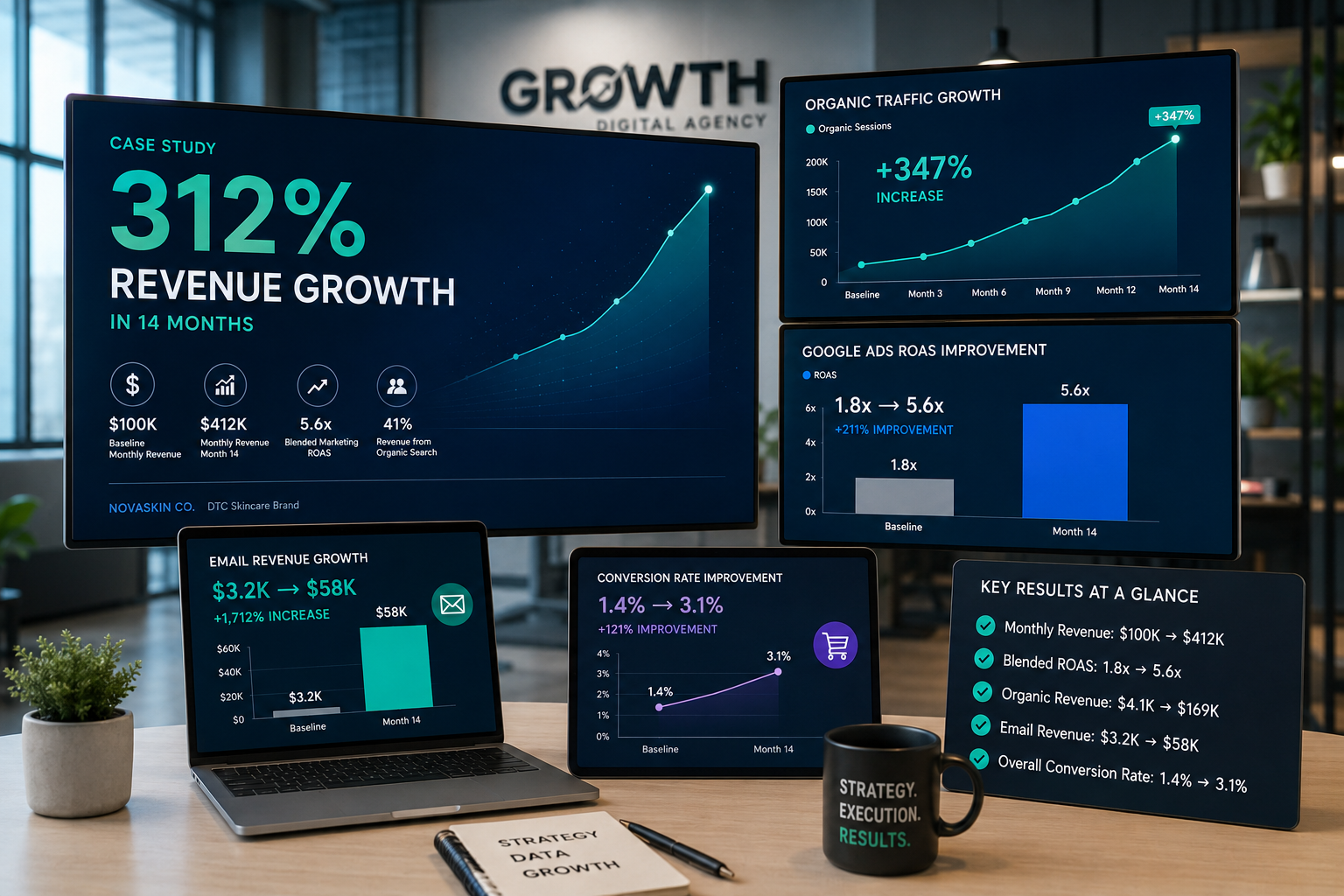
| Monthly Revenue | $100,000 | $412,000 | +312% |
| Annual Revenue Run Rate | $1.2M | $4.9M | +308% |
| Blended Marketing ROAS | 1.8x | 5.6x | +211% |
| Monthly Marketing Spend | $18,000 | $24,000 | +33% |
| Revenue Per Dollar Spent | $5.56 | $17.17 | +209% |
Channel-Specific Results
SEO and Organic
- Organic traffic: +347%
- Organic revenue: $4,100/month → $169,000/month
- Page 1 keyword rankings: 0 → 31
- Domain Rating: DR22 → DR51
Paid Search (Google Ads)
- ROAS: 1.8x → 5.6x
- CPA: $38 → $14
- Shopping revenue share: 34% of paid revenue
Email Marketing
- Monthly email revenue: $3,200 → $58,000
- List size: 14,000 → 41,000
- Automated sequence revenue: $34,000/month
Paid Social (Meta)
- Contributing $47,000/month by Month 14
- First-purchase CPA: $12.40
- Return customer revenue: $18,000/month
Conversion Rate Optimization
- Overall site conversion rate: 1.4% → 3.1%
- Mobile conversion rate: 1.2% → 2.4%
- Checkout completion rate: 61% → 74%
Key Strategic Lessons From This Campaign
- Fix before you scale
- Organic and paid are multipliers, not alternatives
- Email is an undervalued revenue channel
- CRO multiplies everything else
As noted in Google's Think with Google research on full-funnel marketing , brands that activate upper, mid, and lower-funnel strategies simultaneously generate significantly stronger revenue outcomes.
What This Case Study Means for Your Business
If your business is experiencing flat growth, underperforming paid campaigns, or near-zero organic traffic contribution, the patterns in this case study are likely familiar.
- Audit your current marketing infrastructure
- Identify performance gaps
- Define a 12–14 month growth objective
- Shortlist agency partners
- Request a discovery audit
The businesses that achieve results like the ones documented in this case study are not exceptional in their products or markets. They are exceptional in the quality of their marketing partnerships and the rigor of their strategic execution.
Article Highlights
Client Background and the Challenge
NovaSkin Co. was a three-year-old DTC skincare ecommerce brand generating $1.2 million in annual revenue with flat growth for 18 months. Despite strong product-market fit and positive customer reviews, the business lacked marketing infrastructure: broken conversion tracking, a technically failing website, unstructured paid campaigns, zero organic content presence, and an underutilized email list of 14,000 subscribers. The agency was hired to accelerate revenue without proportionally increasing ad spend.
Discovery, Audit, and Strategy Development
A four-week comprehensive audit revealed the root causes of stagnant growth: Core Web Vitals failures with 6.2-second mobile load times, 47 broken pages from a prior migration, Google Ads campaigns with a 4.2 Quality Score and no purchase conversion tracking, and zero blog content despite active competitors publishing 200–400 posts each. The strategy was built across three parallel workstreams: foundation fixes in months one through three, an organic content engine running through month fourteen, and immediate revenue acceleration through restructured paid campaigns and email automation.
Execution: Phase-by-Phase Campaign Results
Phase one technical fixes reduced mobile LCP from 6.2 to 1.9 seconds, improved Google Ads ROAS from 1.8x to 3.1x, and generated $8,400 per month from a new cart abandonment email sequence within the first three months. Months four through eight saw organic traffic grow 187%, Domain Rating rise from DR22 to DR38, and monthly revenue reach $186,000. The final phase added CRO improvements that lifted site conversion rate from 1.4% to 3.1% and mobile conversion from 1.2% to 2.4%.
Final Results: 14-Month Campaign Outcomes
By month fourteen, monthly revenue had grown from $100,000 to $412,000—a 312% increase—while marketing spend increased only 33%. Organic search revenue grew from $4,100 to $169,000 per month. Email revenue expanded from $3,200 to $58,000 per month. Paid search ROAS improved from 1.8x to 5.6x. A newly launched Meta Ads channel contributed $47,000 per month. The overall revenue per marketing dollar spent improved from $5.56 to $17.17—a 209% efficiency gain.
Key Strategic Lessons and CTA
Four principles drove this campaign's success: fix broken infrastructure before scaling spend; use organic and paid as multipliers rather than alternatives; treat email as a primary revenue channel requiring strategic automation; and deploy CRO as the highest-leverage investment in any full-funnel strategy. Businesses experiencing flat growth, underperforming ads, or minimal organic contribution should begin with a comprehensive infrastructure audit, define a 12–14 month revenue objective, and seek agency partners with documented case studies relevant to their industry and business model.
Article FAQs
What does a successful digital marketing agency campaign look like?
A successful digital marketing agency campaign is built on four foundations: a comprehensive audit before any strategy is proposed, a phased execution plan that fixes infrastructure before scaling spend, integrated multi-channel execution where SEO, paid media, email, and CRO work together as a compounding system, and rigorous measurement tied to revenue outcomes rather than vanity metrics. The case study documented here achieved 312% revenue growth in 14 months by following exactly this framework—beginning with technical SEO fixes and conversion tracking setup before scaling organic content, paid campaigns, and email automation simultaneously.
How long does it take for a digital marketing agency campaign to show results?
Results timelines vary by channel and starting conditions. In this case study, paid advertising improvements delivered measurable ROAS gains within the first 90 days after campaign restructuring. Email automation generated $8,400 in new monthly revenue within the first six weeks of implementation. Organic SEO began showing meaningful traffic growth by month four and became a primary revenue driver by month eight. Full-funnel compounding—where all channels amplify each other—typically becomes visible at the 6–9 month mark. Businesses should plan for a 12–14 month horizon to realize the full potential of an integrated agency campaign.
What was the ROI of the digital marketing agency campaign in this case study?
The campaign in this case study delivered a 312% increase in monthly revenue—from $100,000 to $412,000—over 14 months while increasing marketing spend by only 33%, from $18,000 to $24,000 per month. Revenue per marketing dollar spent improved from $5.56 to $17.17, a 209% improvement in marketing efficiency. The blended ROAS across all paid channels improved from 1.8x to 5.6x. Email revenue alone grew from $3,200 to $58,000 per month with no additional ad spend—representing one of the highest-ROI individual channel improvements in the campaign.
What is the most important first step in a digital marketing agency campaign?
The most important first step in any agency campaign is a comprehensive audit of existing marketing infrastructure before any new strategy is proposed or budget is spent. In this case study, the audit revealed critical issues including broken conversion tracking, a technically failing website, structurally unsound paid campaigns, and zero organic content presence—all of which were actively suppressing performance. Fixing these foundation issues in months one through three unlocked significant performance gains across every channel before a single dollar of additional investment was made. Skipping the audit phase and jumping directly to campaign execution is the most common and costly mistake in agency partnerships.
How did SEO contribute to the revenue growth in this case study?
SEO contributed substantially to the 312% revenue growth through three mechanisms. First, technical SEO fixes—resolving 47 broken pages, improving mobile load time from 6.2 to 1.9 seconds, and implementing proper structured data—removed the barriers that had been actively suppressing organic rankings. Second, a strategic content program published 94 SEO-optimized blog posts and six pillar pages over 14 months, building topical authority that drove 31 Page 1 keyword rankings from a baseline of zero. Third, a digital PR and link-building campaign raised Domain Rating from DR22 to DR51, amplifying the ranking power of all content. By month 14, organic search contributed 41% of total revenue—$169,000 per month from a near-zero baseline.
What role did email marketing play in this campaign's success?
Email marketing was one of the highest-ROI components of the entire campaign, growing from $3,200 to $58,000 in monthly revenue—an 1,713% increase—without any increase in ad spend. The agency built a six-sequence email automation architecture covering welcome, educational nurture, cart abandonment recovery, post-purchase follow-up, replenishment reminders, and win-back campaigns. The cart abandonment sequence alone generated $8,400 per month within its first six weeks of operation. The email list also grew from 14,000 to 41,000 subscribers over the campaign period, creating a compounding owned-audience asset that reduced long-term paid acquisition dependency.
How does conversion rate optimization (CRO) affect digital marketing campaign results?
Conversion rate optimization is the highest-leverage investment in any digital marketing campaign because it multiplies the revenue impact of every other channel simultaneously. In this case study, CRO improvements increased the overall site conversion rate from 1.4% to 3.1%—meaning every traffic source now converts 2.2x more visitors into paying customers. Specific interventions included A/B testing product page layouts (increasing add-to-cart rate from 4.1% to 6.8%), simplifying the checkout flow from five to three steps (improving completion rate from 61% to 74%), implementing social proof modules (increasing purchase conversion by 31%), and optimizing mobile UX (doubling mobile conversion rate from 1.2% to 2.4%). These improvements required no additional ad spend and benefited organic, paid, and email traffic equally.
What made this digital marketing campaign different from typical agency work?
Four strategic principles differentiated this campaign from typical agency executions. First, the agency fixed broken infrastructure before scaling spend—addressing technical SEO, tracking, and campaign structure issues that most agencies overlook in favor of immediately deploying new campaigns. Second, all channels were designed to work as an integrated system: SEO content built remarketing audiences that improved paid campaign efficiency; paid campaigns drove email subscribers that reduced acquisition costs; CRO improvements amplified the revenue impact of every traffic source. Third, email was treated as a primary revenue channel requiring strategic automation architecture rather than a secondary broadcasting tool. Fourth, measurement was built on accurate revenue data from day one, enabling rapid optimization decisions based on actual business outcomes rather than proxy metrics.
Can a small business achieve results like this with a digital marketing agency?
Yes—the principles that drove 312% revenue growth in this case study apply to businesses of all sizes. The client in this case study was a small business generating $1.2 million annually with an $18,000 monthly marketing budget when the campaign began. The most important determinants of campaign success are not company size but rather: the quality and thoroughness of the initial audit, the willingness to fix foundational infrastructure before scaling spend, commitment to a 12–14 month strategy rather than expecting overnight results, and an agency partnership built on clear KPIs, transparent data ownership, and genuine strategic alignment. Small businesses often see proportionally larger early gains because their baselines have more accessible upside from basic technical and structural improvements.
What metrics should I track to measure a digital marketing agency campaign's success?
The most important metrics to track across an integrated digital marketing agency campaign include: monthly revenue by channel (organic, paid search, paid social, email, direct); blended ROAS and channel-specific ROAS for all paid campaigns; organic traffic growth and keyword ranking progression by position tier; cost per acquisition (CPA) across each paid channel; email revenue and automated sequence performance; site conversion rate overall and by channel segment; customer acquisition cost (CAC) versus customer lifetime value (CLV); and Domain Rating for SEO authority tracking. Critically, all measurement should begin with accurate GA4 ecommerce tracking and transaction-level conversion data—without which no channel performance can be accurately attributed or optimized.
About Vertex Cyber Tech
Vertex Cyber Tech editorial team.