Write a complete guide about choosing a digital marketing agency in 2026
Learn how to choose the right digital marketing agency in 2026 with our expert guide covering evaluation criteria, red flags, and proven selection strategies.
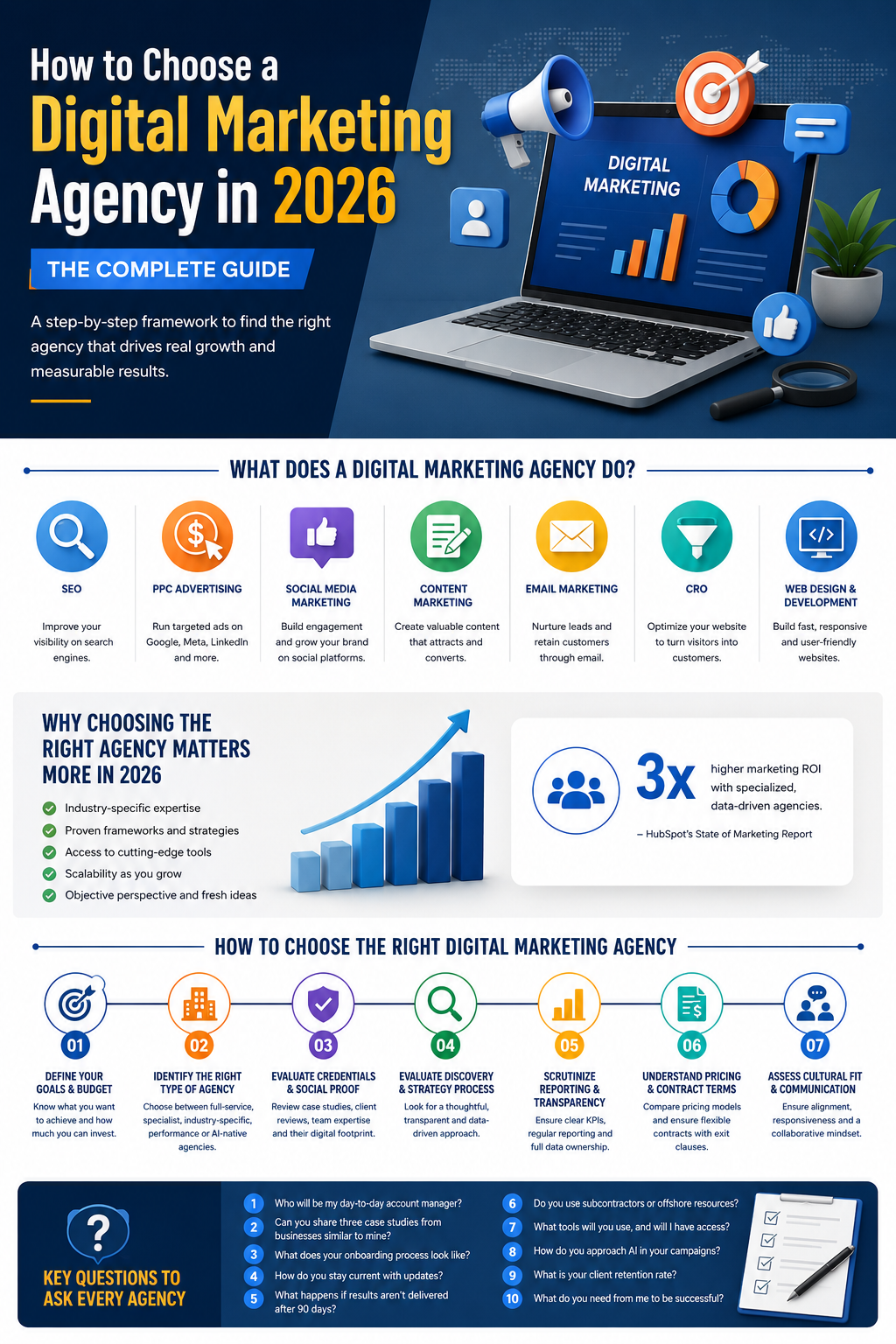
How to Choose a Digital Marketing Agency in 2026: The Complete Guide
Choosing the right digital marketing agency in 2026 is one of the most consequential business decisions you'll make this year. With over 500,000 digital marketing agencies operating globally—and new ones launching every week—the options are overwhelming, and the stakes are high.
A great agency accelerates your growth, builds your brand, and delivers measurable ROI. A poor choice drains your budget, wastes months of momentum, and leaves your competitors pulling ahead. This guide gives you a structured, expert-backed framework to make the right call.
What Is a Digital Marketing Agency?
A digital marketing agency is a service provider that plans, executes, and manages online marketing strategies on behalf of businesses.
- Search Engine Optimization (SEO): Improving your organic visibility on Google and other search engines.
- Pay-Per-Click Advertising (PPC): Running paid campaigns on Google Ads, Meta Ads, LinkedIn, and more.
- Social Media Marketing: Building audience engagement and brand presence across social platforms.
- Content Marketing: Creating blog posts, videos, infographics, and other assets.
- Email Marketing: Nurturing leads and retaining customers.
- Conversion Rate Optimization (CRO): Improving website conversion rates.
- Web Design & Development: Building and optimizing websites.
Why Choosing the Right Agency Matters More in 2026
The digital marketing landscape has shifted dramatically. Google's AI-powered search, Generative Engine Optimization (GEO), and changing consumer behavior require more sophisticated strategies than ever before.
- Industry-specific expertise
- Proven frameworks
- Access to advanced tools
- Scalability
- Objective perspective
Step-by-Step Framework to Choose a Digital Marketing Agency
Step 1: Define Your Goals and Budget Before You Shop
Before requesting proposals, define your objectives, budget, timeline, and service requirements.
- What specific outcome do I need?
- What is my realistic monthly budget?
- What is my timeline?
- Do I need a full-service agency or a specialist?
Budget Benchmarks in 2026
- Startup/SMB: $2,000–$8,000/month
- Mid-Market: $8,000–$25,000/month
- Enterprise: $25,000+/month
How to Evaluate a Digital Marketing Agency Proposal
| Criteria | Weight | What to Look For |
|---|---|---|
| Strategic Clarity | 25% | Clear, custom strategy tied to your goals |
| Relevant Experience | 20% | Industry-specific case studies |
| Team Credentials | 20% | Verified expertise |
| Reporting Framework | 15% | Defined KPIs and reporting cadence |
| Pricing Transparency | 10% | No hidden fees |
| Contract Flexibility | 10% | Reasonable exit clauses |
Ready to Find Your Digital Marketing Partner?
- ✅ Define your goals and budget first
- ✅ Match agency type to your needs
- ✅ Conduct due diligence
- ✅ Review transparency and reporting
- ✅ Start with a paid pilot project
The right agency won't just execute tactics—they'll become a genuine growth partner invested in your business outcomes.
Start your agency search today using the framework above, and shortlist your first three candidates within the next two weeks.
Article Highlights
What Is a Digital Marketing Agency?
A digital marketing agency plans, executes, and manages online marketing strategies for businesses across channels including SEO, PPC, social media, content marketing, email, CRO, and web development. In 2026, leading agencies also offer AI-driven analytics, marketing automation, and first-party data strategy
Step-by-Step Framework to Choose the Right Agency
Follow a 7-step selection process: define your goals and budget, identify the right agency type, evaluate credentials and case studies, assess their discovery process, scrutinize reporting transparency, understand pricing models and contracts, and evaluate cultural fit before committing
Key Red Flags to Avoid When Hiring a Digital Marketing Agency
Watch out for agencies that guarantee #1 Google rankings, demand long lock-in contracts without performance clauses, present cookie-cutter proposals, offer vague deliverables, or resist sharing ownership of your ad accounts and data assets.
Emerging Digital Marketing Trends Agencies Should Master in 2026
Top agencies in 2026 have built expertise in Generative Engine Optimization (GEO), first-party data strategy, AI-powered creative testing, predictive lead scoring, and short-form video SEO for platforms like TikTok, Instagram Reels, and YouTube Shorts.
Start Your Agency Search: Action Plan and CTA
Use the evaluation framework in this guide to define your goals, shortlist 5–8 agencies, run a paid pilot project, and make your final decision based on data and transparency—not pitch decks. Begin your search today and shortlist your first three candidates within two weeks.
Article FAQs
How much does a digital marketing agency cost in 2026?
Agency costs in 2026 vary by scope and business size. Startups and SMBs typically spend $2,000–$8,000 per month, mid-market companies invest $8,000–$25,000 per month, and enterprise-level campaigns often exceed $25,000 per month. These fees typically cover management and strategy; ad spend is usually billed separately on top.
How long does it take to see results from a digital marketing agency?
Timeline depends heavily on the channel. Paid advertising (PPC) can generate results within days to weeks. SEO typically requires 3–6 months to show meaningful organic traffic growth. Content marketing and brand-building initiatives operate on 6–12 month horizons. Any agency promising dramatic SEO results within 30 days should be treated with skepticism.
What is the difference between a full-service agency and a specialist agency?
A full-service agency manages all digital marketing channels under one roof, providing a single point of accountability. A specialist agency focuses deeply on one discipline—such as SEO, paid social, or email marketing. Full-service agencies suit businesses wanting integrated strategy; specialist agencies excel when you have a specific, well-defined channel need or already have in-house capacity in other areas.
Should I own my advertising accounts and data when working with an agency?
Yes, absolutely. You should always retain ownership of your Google Ads account, Meta Business Manager, GA4 property, website, domain, and all creative assets. If an agency insists on owning these assets on your behalf, walk away. Account ownership protects you if the relationship ends and ensures your historical data and campaign learnings remain accessible.
What questions should I ask a digital marketing agency before hiring them?
Key questions include: Who will manage my account day-to-day? Can you provide industry-relevant case studies? What does your onboarding process look like? How do you report results and on what cadence? What happens if results fall short after 90 days? Do you use subcontractors? How are you integrating AI into current campaigns? What is your client retention rate?
What is Generative Engine Optimization (GEO) and why does it matter in 2026?
Generative Engine Optimization (GEO) is the practice of optimizing content to appear in AI-generated search answers from platforms like Google AI Overviews, ChatGPT, and Perplexity. As AI-driven search reshapes how users discover information, agencies that understand GEO help clients maintain visibility in an environment where traditional blue-link rankings are increasingly supplemented or replaced by AI-generated responses.
How do I evaluate a digital marketing agency proposal?
Score proposals across six weighted criteria: strategic clarity and customization (25%), relevant industry experience and case studies (20%), named team credentials (20%), reporting framework and KPIs (15%), pricing transparency (10%), and contract flexibility with clear exit clauses (10%). Avoid choosing purely on price—the lowest bid rarely delivers the best outcome in digital marketing.
Is it better to hire a digital marketing agency or build an in-house team?
An agency is typically the better choice for businesses spending under $50,000 per month on marketing, those needing multi-channel expertise without the overhead of multiple hires, and companies that want flexibility to scale up or down. In-house teams become more cost-effective above the $50K/month threshold or when your brand requires highly nuanced, real-time content production. Many mature companies run a hybrid model.
What are the biggest red flags when evaluating a digital marketing agency?
Major red flags include: guaranteed Google rankings (no ethical agency can promise this), contracts longer than 6 months without performance clauses, no clear reporting or dedicated account manager, proposals that aren't customized to your business, vague or undefined deliverables and KPIs, and resistance to transferring ownership of your accounts and data upon contract termination.
How do I run a paid pilot with a digital marketing agency?
A paid pilot is a short-term, scoped engagement—typically 30 to 90 days—designed to test the agency's capabilities before committing to a long-term contract. Define a specific deliverable (one PPC campaign, one month of SEO work, a content sprint), agree on success metrics upfront, and evaluate the output against those benchmarks before signing a retainer. It is the most reliable predictor of long-term agency performance.
About Vertex Cyber Tech
Vertex Cyber Tech editorial team.


